


International shipping is rarely a direct process. While goods move from the factory to the destination, taxes and customs inspections often cause unexpected delays. Bonded warehouse helps manage these interruptions. Rather than paying import duties immediately upon arrival, these facilities let you store inventory under government supervision until you decide the next step.
You can sell to local buyers, re-export the items, or wait for market demand to rise. This guide looks at bonded storage through a practical lens. It skips the abstract definitions to focus on daily operations, financial benefits, and the common pitfalls that businesses face when they mismanage their customs-controlled stock.
What Is a Bonded Warehouse and Why Does It Matter
A bonded warehouse is a site authorized by customs where imports stay without immediate payment of duties or taxes. Fees are due only when products move into the domestic market. That delay provides the primary advantage. For many companies, import taxes demand a massive cash payment at a difficult moment, long before a sale happens. Bonded storage shifts that financial burden.
Customs bonded warehouses support several operational goals
- Improved Cash Flow – You defer tax payments until items are sold locally, keeping capital available for other business needs.
- Tax-Free Re-Exporting – If you eventually ship goods to another country, you avoid paying domestic duties entirely.
- ⦁ Strategic Regional Placement – You can stage products near your final customers well before you need to clear them through customs.
- Inventory Buffering – Storage provides a safety net for unpredictable demand without the immediate pressure of import fees.
These facilities are most effective when handling high volumes or multi-country sales. They provide a level of financial flexibility that traditional importing cannot match by decoupling the physical arrival of goods from tax liability.
How a Customs Bonded Warehouse Works
The logistics cycle begins when shipments reach the border. Instead of clearing customs through standard channels, the freight moves under bonded status directly to a certified warehouse. At this entry point, the importer has not yet paid any duties or national taxes.
Once the inventory is secured within the facility, it remains under the legal supervision of customs authorities. Every movement is logged to ensure the physical stock matches the digital manifest. Within these walls, several operational tasks are permitted to prepare products for their final destination:
- Long-Term Preservation: Keeping seasonal or high-volume stock for months or years until the market is ready for a release.
- Inventory Segmentation: Breaking down bulk shipments into smaller groups or sorting items based on quality or SKU.
- Regional Localization: Applying new labels, safety warnings, or instructions that meet the specific legal requirements of different target countries.
- Order Fulfillment Preparation: Repacking individual units into bundles or specialized kits ready for retail distribution.
While heavy manufacturing is forbidden, light processing remains a common use case. When goods finally exit the facility, they follow one of three paths:
- Domestic Entry: Products enter the local supply chain, and all deferred duties and taxes are paid in full.
- International Re-export: The items are shipped to another country, meaning no local import fees are ever assessed.
- Bonded Transfer: Stock moves to a different authorized warehouse to maintain its tax-deferred status
Each withdrawal requires precise paperwork to close the loop with customs and reconcile the remaining inventory.
Types of Bonded Warehouses You Should Know
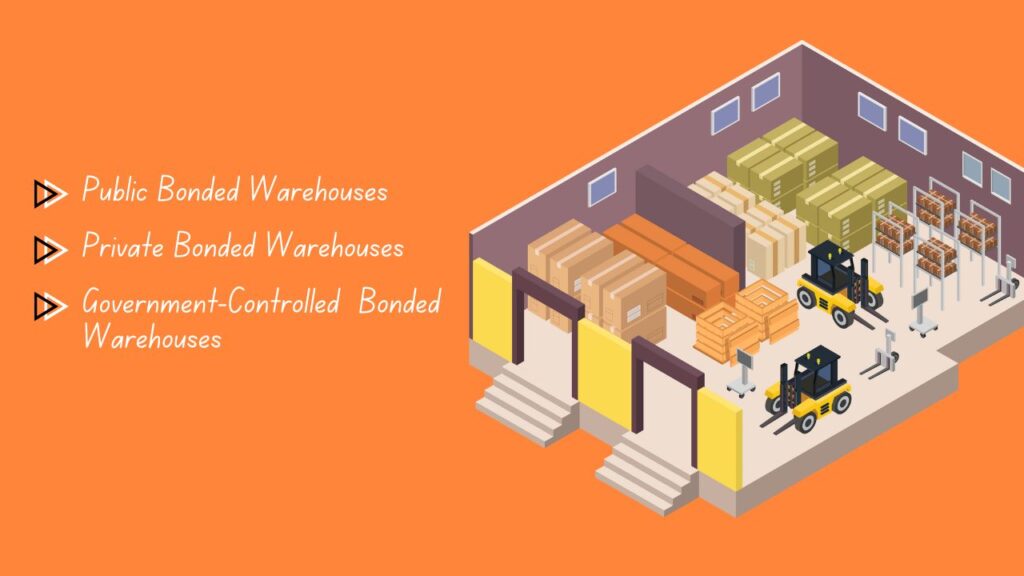
Different structures and ownership models change how bonded storage functions. Selecting a facility depends on your inventory volume, budget, and the level of control your supply chain requires.
Public Bonded Warehouses
These sites operate as third-party facilities that house goods for multiple businesses simultaneously. You rent pallet space or square footage based on your current stock levels. Public facilities are ideal for smaller companies or brands with seasonal spikes that do not want to manage their own building. The primary benefit is flexibility; you only pay for what you use. However, you may face higher handling fees and less direct control over daily warehouse workflows.
Private Bonded Warehouses
A single company owns or leases the entire facility to store its own imported inventory. This model is best for high-volume importers who move consistent amounts of stock and need dedicated space. By managing your own site, you gain total control over security, handling procedures, and staffing. While this setup eliminates third-party service fees, it requires a significant investment in infrastructure, specialized staff, and ongoing maintenance.
Government-Controlled Bonded Warehouses
In some regions, customs agencies or state-run organizations manage these facilities directly. They are often located near major ports or border crossings. While these sites are highly secure and provide clear access to customs officials, their services are generally basic. Availability can be limited, and they may lack the advanced tracking technology found in private or public commercial alternatives.
Specialized Bonded Facilities
Certain products demand more than standard storage. Temperature-sensitive pharmaceuticals, high-value electronics, and hazardous materials all come with handling requirements that cannot be improvised. Specialized warehouses address those needs through climate-controlled zones, higher security standards, and reinforced areas built for sensitive or regulated goods. Oversight is tighter and storage costs run higher, but these facilities protect product integrity while duties remain deferred.
Selecting the wrong type of warehouse often causes avoidable problems. Inadequate conditions can slow operations or lead to added costs later. The decision usually comes down to balance. Public facilities offer lower overhead, while private or specialized warehouses provide tighter control and consistency. The right choice depends on the product, not just the price.
Key Benefits of Using a Bonded Warehouse
Bonded warehousing delivers advantages that tend to show their value gradually. The impact is rarely obvious on day one. Over time, though, the difference becomes noticeable, especially in how money, inventory, and decisions line up.
Duty Deferral
With bonded storage, duties and import taxes are paid only when goods are released into the local market. Until that point, inventory can sit without triggering those charges. This changes how cash moves through the business. Instead of paying large sums upfront and waiting for sales to catch up, funds remain available for operations, restocking, or unexpected expenses. For businesses working with tight margins, that timing difference can ease pressure more than any rate discount.
Re-Export Efficiency
When inventory ships from a bonded warehouse to another country, local import duties do not apply. This matters for businesses serving multiple markets from one location. Products can arrive, wait, and then move on without being taxed in a country where they were never sold. Over time, this avoids paying the same type of charges more than once.
Inventory Positioning
Bonded warehouses allow goods to sit closer to customers without forcing an early commitment. Inventory can be placed near key regions while final destinations remain undecided. This setup helps businesses respond faster once demand becomes clearer.
Market Flexibility
Sales rarely follow forecasts exactly. Bonded storage allows companies to pause before releasing inventory. Decisions happen with real data rather than assumptions made weeks earlier.
Reduced Financial Risk
Unsold stock does not create duty expenses. During slow periods or demand swings, this reduces exposure. The cost still exists, but it arrives later, when sales or exports justify it.
Bonded storage does not remove costs. It shifts when those costs appear, which often makes them easier to manage.
Bonded Warehouse vs Foreign Trade Zone: Key Differences
Bonded warehouses and Foreign Trade Zones often get mentioned in the same conversations, which creates confusion. They serve different purposes, even though both operate under customs oversight.
A bonded warehouse is built around control and containment. Goods enter, remain under supervision, and leave with duties applied only when required. The scope stays narrow by design. A Foreign Trade Zone works more like a defined commercial area, offering broader freedom in how goods are handled before reaching the domestic market.
Key contrasts show up quickly:
- Bonded warehouses limit activities to storage and basic handling
- Foreign Trade Zones permit manufacturing, assembly, and product changes
- Bonded storage works best for short to medium holding periods
- FTZs support long-term operational planning and transformation
The choice often depends on what happens to the product while it sits.
If inventory needs to be staged, sorted, or held while sales decisions take shape, bonded warehousing fits naturally. It keeps costs deferred and operations straightforward. When products require alteration, assembly, or extended processing before sale, an FTZ offers room to operate without constant customs intervention.
Neither option is universally better. Each solves a different problem. The mistake happens when businesses choose based on labels instead of workflow.
Real-World Use Cases for Bonded Warehouses
Bonded warehouses show up in many supply chains without drawing much attention. They sit in the background, supporting decisions rather than driving them.
Cross-Border E-commerce Operations
Brands often move large volumes of inventory into bonded storage and wait. Orders ship internationally as they come in, while duties apply only to items entering a specific market. Unsold units remain untouched from a tax standpoint, which helps manage margins when order patterns shift.
Seasonal Retail Inventory
Seasonal goods tend to arrive well before demand peaks. Bonded storage allows inventory to land early and move out gradually. Duties follow the same pace as sales, rather than hitting all at once.
Market Entry Testing
When entering a new country, committing fully can be risky. Bonded storage lets businesses hold stock locally while tracking actual demand. Full importation happens only after sales justify it.
Global Distribution Hubs
Manufactured goods often reach a central bonded location, then move out to multiple regions. This avoids repeated duty payments as inventory changes destination.
Regulated Product Categories
Products under tighter controls rely on bonded environments that support consistent documentation and traceability.
Across these cases, the logic stays simple. Wait to lock in costs until decisions carry more certainty.
Compliance, Documentation & Legal Requirements
Bonded warehousing runs on structure. The flexibility it offers depends entirely on how well that structure is maintained. Documentation is not a side task here. It sits at the center of daily operations.
Common Requirements
Certain elements are non-negotiable and remain in place from the moment goods arrive:
- Import and shipping documents that match physical inventory
- Unit-level tracking to account for every item in storage
- Customs bonds are issued through licensed providers to secure duty exposure
- Periodic audits and scheduled reporting to customs authorities
These requirements apply regardless of shipment size or storage duration.
Beyond the paperwork, oversight stays constant. Customs authorities keep a close watch on bonded warehouses, and inspections do not always follow a schedule. Checks may occur when goods arrive, while inventory sits in storage, or right before release. Minor discrepancies rarely stay minor for long.
Problems build fast in this environment. A missing form, a quantity that does not match records, or a classification entered incorrectly can stall shipments or trigger fines. In some situations, operations are paused until issues are resolved. More serious violations carry heavier consequences. Bonded privileges can be withdrawn, leaving businesses to pay duties immediately or move inventory out under pressure.
System Alignment
Technology plays a quiet but critical role. Systems managing bonded storage must keep inventory records, customs data, and shipping information aligned at all times. Manual tracking increases risk, especially as volume grows.
When records drift out of sync, issues surface fast. Resolving them often takes longer than expected and can interrupt normal operations.
Bonded warehousing works smoothly only when compliance is treated as part of the daily workflow, not as a periodic check.
Costs, Risks & Limitations to Consider
Bonded warehousing changes how costs appear. Some expenses get delayed, others surface in new places. Understanding both sides prevents surprises later.
Typical Costs
Certain charges apply regardless of duty deferral:
- Storage fees are based on space and duration
- Handling and processing charges for receiving, sorting, or repacking
- Bond premiums required to secure goods under customs control
- Compliance administration is tied to reporting and audits
These costs are generally predictable, though they add up if inventory sits longer than planned.
Operational Risks
Daily operations inside bonded storage come with exposure points:
- Inventory holds during customs inspections or spot checks
- Documentation mismatches between physical stock and records
- Delays caused by incorrect product classification or paperwork errors
Most issues stem from process discipline rather than the warehouse itself.
Structural Limits
Bonded storage also comes with boundaries:
- Processing activities remain restricted
- Storage time limits vary by country and product type
- Some goods are not eligible for bonded treatment at all
Bonded storage works best as a targeted tool. It supports specific trade scenarios but does not replace domestic warehousing or standard fulfillment across every operation.
FAQs
Time limits depend on local regulations, often ranging from one to five years.
Duties are deferred. They apply once goods enter the domestic market unless items are re-exported.
Yes, but duties apply at the point of domestic release.
Yes, especially for companies managing cash carefully or testing demand.
Many cross-border ecommerce operations rely on bonded warehouses for staged distribution.
Conclusion
A bonded warehouse is not a workaround or a loophole. It exists as part of the trade framework and works only when handled correctly. When used with intention, it gives businesses space to think. Cash does not disappear upfront. Inventory choices feel less rushed. Exposure stays contained instead of piling up early. Bonded warehousing suits companies moving goods across borders, dealing with uneven demand, or carrying products with high duty costs.
It requires order, clean records, and planning that extends beyond a single shipment. Without that, the advantages fade quickly. Providers like NextSmartShip build systems around this structure, helping businesses manage bonded inventory alongside hybrid fulfillment, global shipping, and day-to-day order fulfillment. When the process is handled well, bonded storage shifts from a compliance task into a tool for better timing, cost control, and smoother movement of goods.