


For eCommerce brands, hybrid fulfillment is emerging as one of the savviest options for fast deliveries, reduced storage expenses, and inventory flexibility. Brands do not rely on a single warehouse, a single country, or one single fulfillment option, but a mixture of domestic warehouses, overseas warehouses, Amazon FBA, 3PL services, and direct from China shipping.
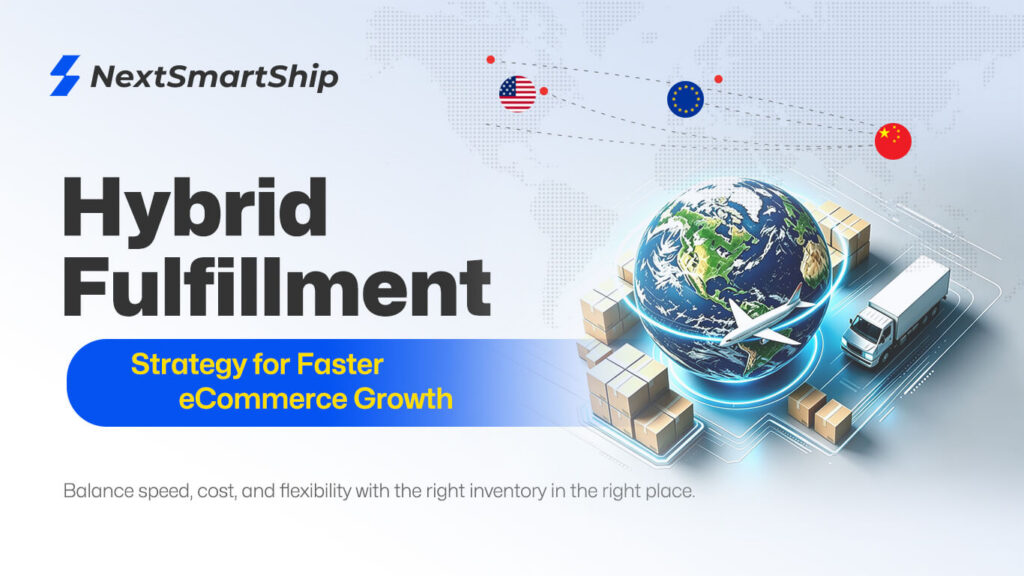
This model is particularly beneficial for sellers in the midst of growth. Deliveries are becoming more and more expected to be quick, but holding all products in district warehouses can be costly. Meanwhile, international shipping can cause a decrease in conversion rates and customer satisfaction by sending all orders abroad. This is where hybrid fulfillment comes in handy, as it enables the right products to be in the right location.
Hybrid fulfillment is not a complicated logistics process, in simple terms. It’s all about strategic fulfillment.
To make this strategy easier to apply, NextSmartShip proposes a practical Hybrid Fulfillment Framework that helps sellers decide where each SKU should be stored and fulfilled based on sales velocity, margin, delivery expectations, and inventory risk.
What Is Hybrid Fulfillment?
Hybrid fulfillment is an approach to logistics that integrates different methods of fulfillment, or different warehouses, to speed up delivery, keep inventory management and operational costs down. A seller could have best-selling products in a US warehouse, slow-moving products in China, orders through the marketplace through FBA, orders through Shopify, TikTok Shop, or wholesale orders by a third-party logistics provider. NextSmartShip supports this model through a practical Hybrid Fulfillment Framework, combining China fulfillment, U.S. warehousing, and multi-channel order routing in one flexible fulfillment network.
The concept is that there is no one-size-fits-all approach to every SKU. If the product is fast-moving, it may be preferable to place it in the local warehouse, as customers want products to be delivered promptly. If the product moves slowly, it can be more cost-effective to store it in the overseas markets in order to lower the storage expenses in the domestic market. A brand new product might first be supplied from China until the seller is assured of its demand.
In contrast to a standard one-warehouse fulfillment, this SKU-based approach is the difference that makes a hybrid fulfillment.
How Hybrid Fulfillment Works
Typically, hybrid fulfillment is made up of three major decisions: when it comes to inventory placement, where to route orders, and who is going to be responsible for fulfillment.
The first is that the inventory is held in multiple locations. SKUs with a high velocity are kept near the customers, e.g., in US warehouses. Lower-cost overseas locations hold overstock of Stock Keeping Units, which are slow-moving or long-tail. This can help prevent the storage fees for items that have low turnover.
Secondly, there is intelligent routing of orders. As an order is received, the system should select the warehouse with the lowest price, fastest service, and the largest inventory. For instance, the US customer who orders a best seller may be sent the product from a US warehouse, and the customer who orders a rare variation may get it from China.
Third, sellers combine different fulfillment channels. An Amazon FBA service may be used for Prime-sensitive marketplace orders, a 3PL service may be utilized for direct-to-consumer orders, and an overseas fulfillment service may be used for international or low-priority SKUs.
Why Hybrid Fulfillment Is Growing
The increased complexity of e-commerce logistics is driving hybrid fulfillment. Hybrid fulfillment is becoming more popular as e-commerce logistics becomes more complex. For customers, speedy delivery is a desired attribute, but it is important for the sellers to avoid losing margins.
In 2025, McKinsey revealed that US consumers are very price-sensitive toward shipping costs and reliability. It mentions that the 90% of consumers are willing to wait 2-3 days for products if they don’t have to pay shipping, and 90% are more likely to drop off products if the shipping cost is high. This implies that for sellers, there will be a requirement to optimize their fulfillment strategy for speed, cost, and reliability, not just speed.
The reason for the storage cost is another one. Having too many SKUs stored in-house can bleed the profit, particularly if the catalog contains slow-moving products, seasonal items, or lots of product variations. Hybrid fulfillment enables sellers to keep products in their own warehouses that warrant their cost.
Also, the volatility of the supply chain is important. The fulfillment process can be hampered by port delays, customs inspections, warehouse congestion, and unexpected surges in demand. Backup options are available with sales when the product is distributed to various stores and sales outlets.
Last, selling in multiple channels is now ubiquitous. Brands sell on Amazon, Shopify, Walmart, TikTok Shop, eBay, and wholesale. While one fulfillment channel often works well, it is typically not the one that is the most efficient for all fulfillment models.
Hybrid Fulfillment vs Traditional Fulfillment
| Fulfillment Model | How It Works | Main Benefit | Main Risk | Best For |
| China-only fulfillment | Orders ship directly from China | Lower storage cost | Longer delivery time | Product testing and slow-moving SKUs |
| US-only fulfillment | Inventory is stored in US warehouses | Faster US delivery | Higher storage cost | Best sellers and high-margin products |
| Amazon FBA-only | Amazon stores and ships products | Prime access and marketplace convenience | Less multi-channel control | Amazon-first sellers |
| Hybrid fulfillment | Sellers combine warehouses and fulfillment methods | Better balance of speed, cost, and flexibility | Requires stronger inventory planning | Growing multi-channel brands |
This comparison shows why hybrid fulfillment is often stronger than a single-method approach. It allows sellers to treat products according to demand, margin, and customer expectations.
Core Components of a Hybrid Fulfillment Strategy
There are four key elements to a successful hybrid fulfillment strategy.
The first one is the filling of the home. Domestic warehouses are ideal for priority shipping areas, high-demand SKUs, and fast-moving products. NextSmartShip’s US warehouse service can help facilitate quicker and more economical fulfillment for customers in the United States, for instance.
The second one is the overseas fulfillment. Overseas warehouses can be used for backup inventory, slow-moving products, product testing, and overseas customers. Sellers may not need to pay high domestic storage fees for each SKU while keeping inventory flexible.
The third is the forecasting of stocks. It is important for the sellers to understand what products sell fast, what products move slowly, and what are seasonal products. Hybrid fulfillment can lead to stock imbalance if there is no sales velocity data.
The fourth one is Technology Integration. For sellers, it is essential to have real-time inventory visibility, automated order syncing, and accurate inventory updates across channels. NextSmartShip stock management service enables you to manage your stock centrally and sync it in real time with an online store.
Common Hybrid Fulfillment Models
There are several ways sellers can use hybrid fulfillment.
Hybrid fulfillment can be utilized by sellers in a variety of ways.
The China-US warehouse model, introduced by NextSmartShip, is one practical approach to hybrid fulfillment. The best-selling products are held in the US for quicker delivery, but long-tail products are kept in China. It is beneficial for those who offer a lot of product variations.
Another version is Amazon FBA with +3PL backup. Amazon fulfills selected marketplace orders, and an external fulfillment partner fulfills oversized products, restricted items, Shopify orders, or overstock.
The third one is regional warehousing. To minimize shipping zones and transit times, inventory is spread among a number of locations, including both East Coast and West Coast warehouses.
The last one is DTC with marketplace fulfillment. One inventory strategy can work for two orders, direct to the consumer website and marketplace, and helps lower dependence on one order path.
Biggest Challenges in Hybrid Fulfillment
The advantages of hybrid fulfillment are evident, but it requires careful management.
The first challenge is the issue of inventory fragmentation. If stock exists in several different warehouses, sellers must have up-to-date visibility. In other cases, one site could be out of stock, while another site has excessive stock.
The second is overselling. Without the proper synchronization, sellers can sell out products that are not available in their stores, such as Shopify, Amazon, warehouse systems, or on TikTok Shop.
The third challenge is operational complexity—the more warehouses, the more carriers and receiving rules, the more customs coordination and reporting requirements.
The fourth challenge is the prediction of errors. Over-investing in a retail warehouse in the country can result in high storage expenses. If the amount sent is insufficient, it results in a stockout and delayed delivery. While hybrid fulfillment can be effective, it is best when sellers base their actions on actual sales data, rather than estimates.
How NextSmartShip Supports Hybrid Fulfillment
NextSmartShip can assist the seller in using the domestic and overseas fulfillment strategies synergically. It also offers eCommerce fulfillment services, such as inventory management, order processing, and package delivery for DTC brands.
To fulfill the China-US hybrid, sellers can store fast-moving inventories in the US warehouses and slow-moving inventories in China. It comes in handy if you are a cross-border seller and require faster delivery for some products, but don’t wish to pay too much for domestic storage for each SKU.
NextSmartShip also provides omnichannel fulfillment. This is important as a lot of sellers are handling orders from Shopify, Amazon, and WooCommerce, as well as from TikTok Shop, Walmart, and other platforms. A flexible fulfillment partner can help sellers eliminate having to keep separate inventories for each channel.
A great benefit is also the SKU-level visibility. To provide hybrid fulfillment, you need to understand the location of every inventory, how fast it’s being sold, and when it needs to be replenished. When it comes to hybrid fulfillment, there can be a lot of confusion if you don’t have the proper SKU-level control.
NextSmartShip will be a useful way to have US warehouse support with overseas inventory flexibility and multi-channel order support for sellers who wish to cut their fulfillment expenses without compromising on their speed of delivery.
Best Practices for Building a Hybrid Fulfillment System
The sellers need to begin with their top sellers. Typically, these products will require the quickest delivery times since they are the products that bring in the most money and impact customer satisfaction the most.
They must also perform a geographic analysis of the customers. Storing top SKUs in US warehouses may help to better serve most buyers in the US. If there is a demand that is worldwide, then a more distributed approach can be better.
Also, safety stock is significant. Buffer inventory for key products should be maintained by sellers for supplier delays, freight disruption, or unexpected surges of demand.
Automation matters too. Maintaining the inventory manually can be hazardous in multiple warehouses and channels. Sellers require systems that will automatically update inventory in real time.
Lastly, ROI needs to be periodically reviewed. Considerations for a hybrid model include storage cost, shipping time, fulfillment cost, inventory turn, and customer satisfaction.
Conclusion
Hybrid fulfillment is a scalable logistics solution that brings together speed, flexibility, and cost control. It supports sellers from shipping all products from overseas and/or keeping all the SKUs at home.
“One warehouse fits all” is not the future of e-commerce fulfillment. Products that move quickly require speed. Slow-moving products require cost control. New products require flexibility in testing. The multi-channel brands require fulfillment systems that are capable of providing seamless integration across various channels without causing any confusion in inventory management.
Hybrid fulfillment is a viable development for sellers with supply chains that are based in China who have to meet demand from customers in the US. Sellers can have the best sellers at the customer’s fingertips, have flexible long tail inventory, lower fulfillment bottlenecks, and scale more sustainably with the right partner.
As a framework proposed by NextSmartShip, hybrid fulfillment gives growing eCommerce brands a more structured way to balance delivery speed, storage cost, inventory flexibility, and multi-channel growth.