


One warehouse is manageable, but it isn’t as efficient if customers are scattered throughout several regions. An order from one end of the country to the other is typically more expensive, takes longer to reach its destination, and travels a greater distance than an order from a nearby facility.
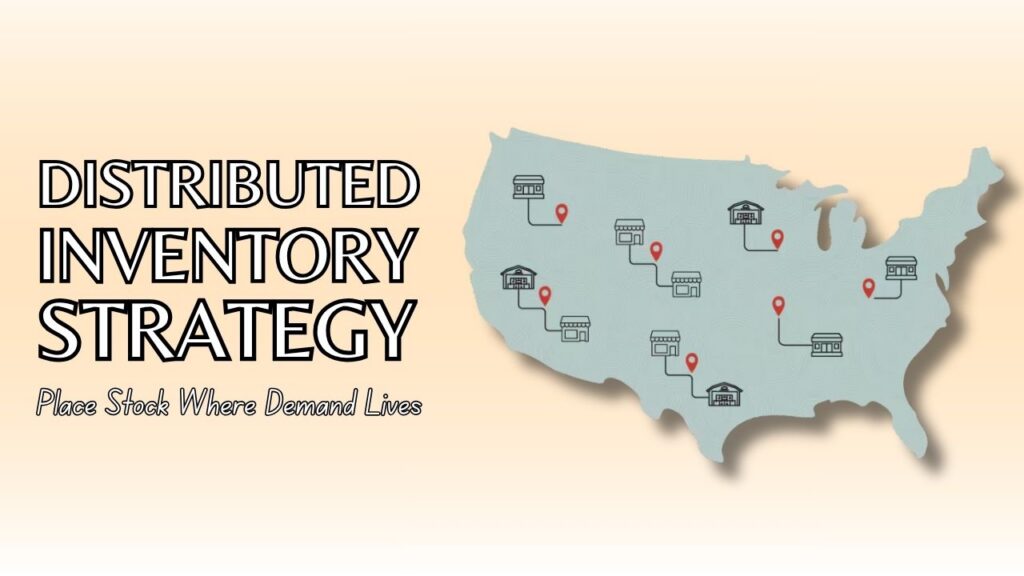
Distributed inventory is the answer, as it distributes selected inventory into two or more warehouses or fulfillment centers. The seller does not focus all the units in one building, but rather on the location with the greatest demand. Upon receiving an order, the fulfillment system determines the location with the most stock, the customer’s shipping address, and the delivery time and shipping cost.
The model can include East Coast and West Coast warehouses, China and U.S. facilities, or a broader international network. It does NOT mean stocking each SKU at each location. The objective is to offer the correct goods at the correct quantity, and with the correct and reliable sales and inventory information.
Why One Warehouse Eventually Becomes Expensive
Centralized inventory offers simplicity: one receiving point, one stock pool, and one replenishment plan. That simplicity can become costly as the business grows.
The 2026 Pitney Bowes Parcel Shipping Index reports that U.S. parcel volume reached 23.1 billion shipments in 2025, increasing 3.3% year over year, and projects about 31 billion parcels by 2031. With increasing parcel delivery volumes, parcel distance and routing are more significant.
There is pressure from customers’ expectations. McKinsey’s 2025 U.S. delivery research showed that reliability trumps speed when it comes to the customer, also indicating that about half of customers track their orders to make sure they are on track. That reliability can be achieved by reducing the distance between inventory and demand via distributed inventory.
The strategy can help sellers achieve:
- Shorter and more predictable delivery routes
- Lower exposure to long-distance shipping costs
- Backup capacity when one warehouse is disrupted
How Stock Moves Through a Distributed Network
A distributed network starts with a planned inventory split. A seller can have lots of products stored in different warehouses across the east and west, with slower-moving products in a central warehouse. It can be a China-based brand that has proven U.S. best sellers but delivers experimental products from China until demand is predictable.
Orders Follow Rules, Not Guesswork
When an order enters the system, routing rules may consider:
- Customer location
- Stock available at each warehouse
- Shipping rate and service level
- Warehouse capacity
- Product dimensions or handling needs
- Promised delivery date
It doesn’t always mean that the closest warehouse is necessarily the best. Another site might have better stock, lower carrier rates, or equipment for fragile, oversized, or customized stock. Good routing is an equilibrium of the three factors: speed, cost, and suitability for operations.
Replenishment Becomes Regional
Forecasting must be done for each location, in addition to the company-level forecasting. If 60% of orders for a SKU come from the eastern United States, the East Coast facility might require a higher share of the next replenishment shipment.
Inventories are not viewed as a goal. There is adequate stock at each location to meet regional demand without overstocking the region.
Centralized and Distributed Inventory Compared

| Decision Area | Centralized Inventory | Distributed Inventory |
| Inventory location | One main warehouse | Two or more warehouses |
| Complexity | Lower | Higher |
| Delivery distance | Longer for remote buyers | Shorter when the stock is near demand |
| Forecasting | Mainly total demand | Regional demand |
| Disruption exposure | One site affects all orders | Other sites may continue fulfilling |
| Inventory requirement | Easier to pool the limited stock | May require more stock |
| Best fit | Low volume or concentrated demand | Consistent regional demand |
Distributed inventory doesn’t necessarily equal good inventory. It will vary based on order size, product margin, the customer’s geographical location, and the seller’s stock management skills.
The SKUs That Deserve More Than One Location
Best Sellers With Predictable Demand
Typically, the best candidates are those who are moving quickly. Their sales history makes regional forecasting more reliable, and their volume provides sellers a greater opportunity to sell the product before storage costs build up.
Heavy or Bulky Products
Shipping big parcels is costly when traveling long distances. Located nearer to customers, they might save on delivery costs, making it worthwhile to invest in the additional warehouse.
Products Where Delivery Influences Conversion
DHL’s 2025 E-Commerce Trends Report found that 81% of shoppers abandon a purchase when their preferred delivery option is unavailable. While sellers don’t necessarily have to guarantee unrealistic delivery times, they can ensure that priority products are closer to customers, thereby enabling more reliable delivery options.
Products With Regional Demand Patterns
Certain products are more successful in certain climates, cities, or customer groups. Regional sales data can indicate whether to stock a SKU in a warehouse or in all warehouses.
Generally, low-volume, experimental, highly seasonal, and long-tail SKUs should remain centralized until the sales trend becomes apparent. A small stock pool can result in stock shortages across multiple locations rather than good availability in one.
Where Distributed Inventory Can Go Wrong
Most often, the issue is an inventory imbalance. Another warehouse can have a sellout, and another can have excess stock. Seller has sufficient units, but not in the right location.
It also becomes more difficult to forecast as total sales will no longer be sufficient. The demand history, lead time, safety stock, and reorder point should be unique for each warehouse.
The model may require more working capital. Several locations must maintain sufficient stock to work safely, leading to more units being kept.
Technology is another must. When products are located in varying warehouses and sold in different venues, paper-based spreadsheets are unsafe. Overselling, split shipments, or routing from a more expensive location can result from delayed updates.
Clear guidelines on where products should go, how they will be inspected, and which warehouse will receive the inventory adjustment are also required for returns.
A Safer Way to Build the Network
Start With a Narrow SKU Group
Don’t send the whole catalog all at once. Start with products that are sure to be in demand, have a healthy profit margin, and can generate several sales plants.
Map Orders Before Selecting Warehouses
Analyze customer orders by State, Region, Country, and Postal Code. The locations and warehouses should be based on proven demand concentration.
Set Reorder Points by Warehouse
A reorder point should be calculated for each location based on its sales rate and lead time. A product may sell out in one warehouse very quickly while remaining in stock at another, and a national rule can hide this fact.
Track the Network by Location
Useful measures include:
- Average delivery time
- Fulfillment cost per order
- Stockout rate by warehouse
- Inventory turnover by location
- Average shipping distance or zone
- Percentage of orders routed from the preferred facility
- Number of split shipments
These measures indicate whether the network is making performance gains or simply making stock more widely available.
Rebalance Before the Gap Becomes Severe
Consider the cost of inventory transfer vs the cost of replenishment from the supplier if one warehouse is stocking out while the other is overstocked. Rebalancing should be based on expected demand, not on equalizing the number of units.
How NextSmartShip Supports Distributed Inventory
NextSmartShip allows sellers to combine domestic and China-based fulfillment, rather than forcing every SKU into a single storage strategy.
Local Coverage for Proven U.S. Demand
NextSmartShip’s USA fulfillment center network provides sellers with domestic storage and fulfillment options for products with proven demand in the USA. High SKUs can be stored closer to the American customer, and low SKUs can be stored further down the value chain.
Centralized Inventory Visibility
The inventory management platform enables sellers to track the status of inventory and SKU quantities in fulfillment. This is key to the concept of distributed inventory working, as the seller must be aware of what’s available, reserved, inbound, damaged, and committed to order.
China-Based Flexibility for Long-Tail Stock
NextSmartShip’s China fulfillment center provides kitting, packing, warehousing, and international shipping close to the source of manufacture. Sellers can leverage China inventory to test, provide backup supply, handle product variations, and fulfill long-tail orders as they move successful products to U.S. fulfillment centers.
This combination allows sellers to:
- Keep priority SKUs nearer to customers
- Avoid placing every variation in higher-cost domestic storage
- Replenish U.S. stock from China as demand becomes clearer
- Adjust SKU placement as sales patterns change
The value comes from using locations selectively. More warehouses do not improve fulfillment unless allocation, routing, and replenishment remain accurate.

Conclusion
Distributed inventory helps eCommerce sellers locate products closer to customers, minimize delivery distances, and provide backup fulfillment capabilities. It’s best suited for a region where demand is predictable across multiple locations and where there is sufficient demand for certain SKUs to support multiple sites.
Complexity is also added to the model. It can be regional forecasting, stock imbalance, or the business may require more working capital. Even a vendor with limited visibility can turn a faster fulfillment approach into a series of isolated inventory issues.
Slowly is the best method. Start from successful top sellers, break down customer geography, define warehouse-level reorder points, and track the performance of each location. Leave slower (and experimental) products centralized until demand is established for broader placement.
Distributed inventory does not necessarily imply many warehouses. It’s about having some commercial purpose for each spot.
Place inventory closer to demand without losing control. Build a faster, more flexible fulfillment network with NextSmartShip.