


Selling out a popular product can lead to lost sales, derailed advertising efforts, and lost customers. The problem with having too much backup inventory is just the opposite: cash is tied up in inventory, and storage fees continue to add up.
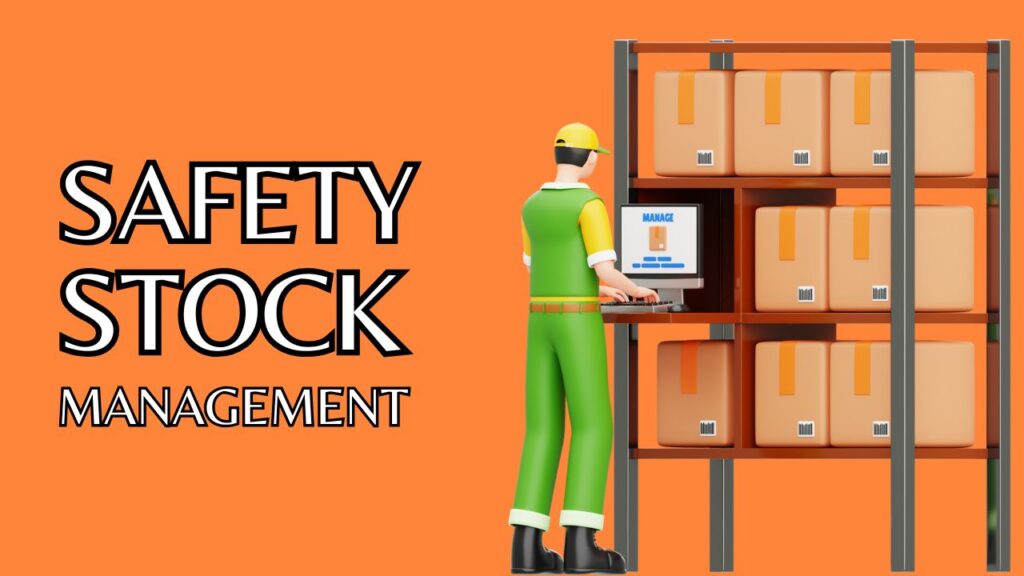
Safety stock management is a balancing act of those risks. Safety stock is extra stock that is used to cushion fluctuations in either demand or supply. It shields the sellers from losses arising from an increase in orders beyond expectation, non-meeting of the production schedule, delayed freight, customs clearance, and delays in the receiving section of the warehouse.
The goal is not to stock up on as much inventory as possible. It should capture the appropriate buffer for each SKU according to the SKU attributes: sales velocity, replenishment lead time, SKU profitability, and SKU disruption exposure.
Why Product Availability Has Become a Revenue Issue
U.S. retail e-commerce sales reached a seasonally adjusted $326.7 billion in the first quarter of 2026, an increase of 9.8% from the first quarter of 2025. With the growing online demand, sellers have more money to lose when the critical SKU goes out of stock.
Availability influences customers’ decisions as well. DHL’s 2026 E-Commerce Trends Report revealed that 67% of online shoppers abandoned a cart due to the delivery offering. When the product is not available or the time to replenish is not known, a seller is unable to give a reliable delivery option.
The pressure of supply has by no means vanished, either. The Federal Reserve Bank of New York in May 2026 said the lengthening of delivery times and the rising of order backlogs were the primary drivers of gains in its Global Supply Chain Pressure Index (GSCPI).
That is precisely the type of uncertainty safety stock is intended to absorb.
What Safety Stock Protects Against
Safety stock covers the gap between what the seller expected and what actually happened.
Demand Spikes
Orders can go up due to paid promotion, an influencer mention, marketplace promotion, seasonality, and viral exposure. Forecast using ONLY Average sales could be wrong if demand suddenly speeds up.
Supplier and Production Delays
A factory can be plagued by a lack of materials, quality-control issues, equipment breakdowns, or vacations. Even a reliable supplier can occasionally miss a planned completion date.
Freight and Customs Disruption
Replenishment time is longer due to ocean schedules, air capacity, port congestion, customs inspections, and documentation errors. Imported products need a buffer that is not only for covering the production time of the factory, but also the whole lead time from abroad.
Warehouse Receiving Time
Just because something is at the warehouse gate, it doesn’t mean it is saleable. It still might need to be counted, inspected, marked, and stored. Receiving and put-away time should be counted as replenishment time.
Forecasting Error
Forecasts are estimates. Product trends change, promotions outperform or underperform, and historical sales may not reflect current demand. Safety stock provides room for those errors.
A Simple Safety Stock Formula
One practical method is:
Safety Stock = (Maximum Daily Sales × Maximum Lead Time) − (Average Daily Sales × Average Lead Time)
Suppose a seller records:
- Maximum daily sales: 100 units
- Maximum lead time: 30 days
- Average daily sales: 60 units
- Average lead time: 20 days
The calculation is:
- Maximum demand during maximum lead time: 100 × 30 = 3,000 units
- Expected demand during average lead time: 60 × 20 = 1,200 units
- Safety stock: 3,000 − 1,200 = 1,800 units
The resulting figure indicates a safety stock of 1,800 units to guard against high demand and a high replenishment time.
This approach is intuitive but may be a pessimistic approach since it represents the combination of two extreme conditions. Advanced sellers can also rely on service-level targets, standard deviation of the demand, variability of the lead-time, and probability-based models.
The choice of method will be determined by the quality of the information available and the costs of being out of stock.
Safety Stock and Reorder Point Are Not the Same
Safety stock answers:
How much extra inventory should the business hold?
The reorder point answers:
At what inventory level should the seller place the next order?
A common formula is:
Reorder Point = (Average Daily Sales × Lead Time) + Safety Stock
Using the earlier example:
Average daily sales: 60 units
Average lead time: 20 days
Safety stock: 1,800 units
The reorder point is:
(60 × 20) + 1,800 = 3,000 units
The seller should start replenishing when the available units are around 3,000 units. The buffer is made up of 1,800 units, and the 1,200 units are expected to be used up during the normal lead time.
| Measure | Purpose |
| Average lead-time demand | Covers expected sales while replenishment is in transit |
| Safety stock | Protects against demand and lead-time uncertainty |
| Reorder point | Triggers a new purchase or inbound shipment |
| Order quantity | Determines how much inventory is replenished |
Why One Buffer Cannot Fit Every SKU
A catalog of products can be approached by using the same number of safety-stock days for all products and this is easy, but generally not correct.
If a product has a high turnover and a high margin, then it might pay to keep a bigger buffer as a stockout would cost a lot. Because the slow-moving variation may result in only small or no safety stock, as the risks of having excess units outweigh the risks of lost sales.
Safety-stock decisions should consider:
- Average and maximum sales velocity
- Supplier and freight lead time
- Lead-time variability
- Product margin
- Storage cost
- Shelf life or obsolescence risk
- Return rate
- Seasonality
- Importance to the wider product range
But protection can be greater for a replacement part that maintains the usability of another product, even if the part itself has a small sales volume. If the accessory is a trend, it could be very short-lived and perhaps need a smaller buffer.
Common Safety Stock Mistakes
Using Old Demand Data
Recent growth or decline, or seasonality, may be masked in a twelve-month average. Sellers should go over the current pattern and distinguish between natural sales periods and promotions or unusual peaks and valleys.
Ignoring the Full Lead Time
Lead time should cover supplier production, supplier quality control, freight booking, freight transport, customs clearance, local transport, receiving, and put away.
Treating Safety Stock as Permanent Overstock
If any of the demand, lead time, or supplier reliability change, the buffer should change. It is not a set figure that does not change year after year.
Protecting Slow Movers Too Aggressively
Excessive inventory for low-demand products can result in long storage time, markdowns, and disposal expenses.
Forgetting Reserved and Unsellable Inventory
Safety stock should not be considered for damaged units, units on order, quarantined returns, and marketplace reservations.
A Better Safety Stock Process
Calculate at SKU Level
Start with products that are sold the most or are most likely to sell out. Don’t use one percentage for the whole catalog: calculate separate buffers.
Segment Products by Risk
Sort SKUs by sales velocity, margin, lead-time uncertainty, and shelf life. Products that replenish slowly and are more valuable require closer monitoring than those of lesser value and risk.
Adjust Before Peak Periods
Boost protection ahead of Black Friday, Cyber Monday, Christmas, product launches, or planned influencers. The adjustment should take place in time to allow for production and freight.
Review Supplier Reliability
Please keep a record of promised and actual production dates. If the supplier has a history of late delivery, it is necessary to have safety stock, order sooner, or find another supplier.
Recalculate Regularly
Review sales velocity, stockouts, supplier performance, inbound delays, storage costs, and forecasting error every month. Fast-changing products may require more frequent reviews.
Balance Buffer Cost Against Stockout Cost
It is an economic decision as to the correct amount. Weigh the price of keeping the extra unit against the potential loss of margin, advertising, customer service, and repeat business.
Using More Than One Fulfillment Location
Hybrid fulfillment allows the elimination of using all your buffer in costly domestic storage.
A seller can maintain active safety inventory in a U.S. warehouse and secondary back-up inventory in China for the bestsellers. Short-term availability is maintained by the domestic stock. The China stock can be used to replenish or satisfy long tail orders if local placement is not cost-effective.
This method only works if you can always see your inventory in all places and if replenishment takes place early enough. When the transit time has not been taken into account, stock from overseas will not solve the problem of a local stockout.
How NextSmartShip Supports Safety Stock Management
NextSmartShip’s inventory management platform serves as a portal of visibility for sellers and keeps inventory information synced across linked stores.
A correct inventory of available, reserved, and incoming quantities is essential to the calculation of any safety stock. The seller must be able to determine the amount of inventory that can actually be sold before determining if the buffer is in danger.
NextSmartShip’s global FBM fulfillment service facilitates real-time stock tracking and reorder-point control in fulfillment operations. This can enable sellers to start replenishing before the unexpected stock is used up in the safety buffer.
Active and backup inventory can also be separated in a China-U.S. model. NextSmartShip’s China fulfillment center enables sellers to store appropriate inventory in proximity to suppliers for kitting, consolidation, storage and international replenishment, while moving high-velocity items closer to highest-priority customers.
A practical workflow is:
- Measure demand and lead-time variability by SKU.
- Set a safety-stock target and reorder point.
- Monitor available, reserved, and incoming units.
- Hold priority inventory near customers.
- Keep suitable backup stock in a lower-cost location.
- Recalculate when demand or supplier performance changes

Conclusion
Safety Stock Management ensures that sales are safeguarded without keeping unnecessary and excessive inventories. The best is the mix of good SKU-level data, realistic total lead times, supplier performance, and frequent review.
A very basic formula for maximum-minus-average can be a good starting point. For large catalogs or for a highly fluctuating demand, the more advanced methods might be more appropriate. In either instance, the size of the buffer should be based on the risk and economics of the product.
Low levels of safety stock result in lost sales and poor availability. Excessive quantities tie up cash and leave more in storage.
It’s not about increasing the warehouse balance. It is a buffer-controlled solution to ensure that the correct products are always in stock and working capital is maintained.
Prevent stockouts without filling your warehouse with unnecessary inventory. Build a smarter safety-stock and replenishment strategy with NextSmartShip.