


A warehouse can be a good choice for an e-commerce business during its initial phase. As orders proliferate throughout the region, though, all those same arrangements can involve parcels in longer travel and higher delivery costs and can make everything reliant on a single facility.
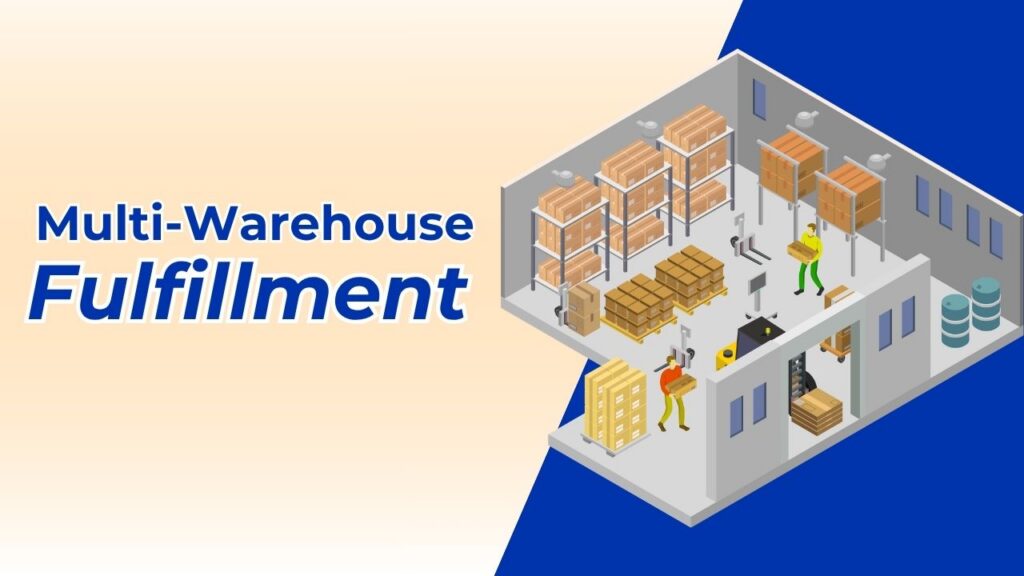
Multi-warehouse fulfillment is a method of fulfillment that ships inventory from two or more fulfillment centers. Stock is split based on customer geography, SKU demand, shipping economics, and operational risk. Upon receipt of an order, the fulfillment system directs it to the location best suited to fulfill the order.
This model can be East Coast and West Coast warehouses, warehouses in various countries, or a combination of warehouses in China and the US, which are simultaneously fast and flexible. Increasing the number of warehouses doesn’t necessarily lead to better fulfillment. The benefits become evident when the inventory allocation, order routing, and replenishment are operated together as one system.
Why does a Single Warehouse Become Less Efficient
The U.S. parcel market continues to expand. The 2026 Pitney Bowes Parcel Shipping Index reports that 23.1 billion parcels were shipped in the United States during 2025, up 3.3% from 2024, and projects a volume of approximately 31 billion by 2031.
For an individual seller, the practical issue is distance. The U.S. Postal Service explains that zoned postage is partly determined by how far a mailpiece travels: the farther it goes, the more zones it crosses and the more postage it may cost.
A company with all its orders coming from one coast thus pays a geographic penalty if a large percentage of its customers are on the other coast. Longer routes may also result in less predictable delivery timeframes and a heightened risk of disruptions in regional carriers.
The delivery performance has an impact on conversion, too. DHL’s 2025 E-Commerce Trends Report found that 81% of shoppers around the world leave behind items in their shopping carts because they could not get their preferred delivery option. Stock closer to the customer can enable more competitive and reliable delivery options.
How Multi-Warehouse Fulfillment Operates
Inventory Is Split Deliberately
Seller’s locations are assigned based on the order history in the region, the demand for each product, and the seller. A popular product can exist in both the eastern and western U.S. warehouses, but a less frequently changing product can be kept in one warehouse.
Rarely is equality of distribution desired. However, when 65% of the demands of a SKU are in the eastern region, this equal split may lead to an inadequate supply in the east and a surplus supply in the west.
Orders Are Routed Automatically
A fulfillment system evaluates the order and selects a warehouse according to factors such as:
- Customer address
- Available inventory
- Shipping cost
- Estimated delivery time
- Warehouse capacity
- Product dimensions or handling requirements
- Marketplace delivery commitments
But the closest isn’t necessarily the best. Another warehouse could offer more stock, a cheaper carrier or have the capacity for a fragile, large, or unique product.
Replenishment Happens by Region
A replenishment plan must be created for each warehouse, taking into account the unique lead time and sales velocity of each location. There shouldn’t be a single reorder point for the entire company for managing regional stock levels.
Even if a fast-moving item SKU is sold in both West and East Coast stores, the safety stock and reorder point levels may vary between the two.
Single-Warehouse and Multi-Warehouse Models Compared
| Decision Area | Single Warehouse | Multiple Warehouses |
| Inventory control | Simpler, with one stock pool | More complex, with several stock pools |
| Shipping distance | Longer for remote customers | Shorter when inventory matches demand |
| Forecasting | Mainly total demand | Regional and warehouse-level demand |
| Disruption risk | One facility affects all orders | Other facilities may continue operating |
| Inventory requirement | Easier to pool the limited stock | May require more units overall |
| Technology need | Moderate | High, with real-time synchronization |
| Best fit | Lower volume or concentrated demand | Stable demand across several regions |
A centralized model remains sensible for new sellers, limited catalogs, and concentrated customer bases. Multi-warehouse fulfillment is beneficial when the benefits and inventory costs outweigh the technology and inventory overheads.
When a Second Warehouse Earns Its Keep
Orders Are Consistently Spread Across Regions
The second site should only be based on confirmed demand and not projected growth alone. Before choosing a warehouse, sellers need to map the orders by state, ZIP code, country, and carrier zone.
Fast-Moving SKUs Can Support the Split
Products that have been around for a while and have a consistent demand are the safest products to distribute. If a small stock pool is split too early, low-volume SKUs can end up not being available in multiple locations.
Shipping Distance Is Damaging the Margin
Products that are heavy, bulky, or large in dimensions can result in the most savings since long-distance delivery is costly. When sellers are working out what they can save on outbound costs, they should offset that with the receiving, storage, and inventory costs.
Delivery Speed Influences Conversion
Regional placement may be suitable for products that have paid advertising, marketplace delivery commitment, or time-sensitive customer needs.
One Facility Creates Too Much Operational Risk
Multiple warehouses offer continuity when faced with severe weather, carrier disruption, capacity issues, and even temporary warehouse issues. Resilience is helpful, but still, routing rules and enough alternate stock are required.
The Problems More Warehouses Can Create
The most common failure is an inventory imbalance. There’s a warehouse that’s empty, and another that has extra units. The business has sufficient inventory in general, but not from the appropriate location.
Predicting is also more difficult. Sellers will need to estimate per-SKU, per-region demand rather than the total demand for the nation. A product can do well overall and yet not move well in one of the warehouses.
Splitting stock may result in greater working-capital needs. Some inventory is necessary at each site to meet orders safely, thus increasing the average inventory.
Other risks include:
- Overselling caused by delayed inventory synchronization
- Split shipments when no warehouse holds the full order
- Duplicate receiving and storage costs
- Expensive transfers between warehouses
- Misrouted returns
- Different packing quality or service levels across locations
These are not reasons to avoid the model. They’re causes to grow strategically and carefully monitor the network.
A Practical Rollout Plan
Begin With a Small Product Group
Choose some of the books you know will be popular and in the black. Don’t make complete catalogs available until it’s evident that savings and service improvements are realized from the initial phase.
Use Actual Customer Geography
Review orders for a minimum of a few months. Determine the customers’ geographical locations, the carriers that provide service to these areas, and the average shipping zone from the current warehouse.
Model the Full Cost
Add inbound freight, receiving, storage, pick and pack, outbound postage, transfers, returns, and capital that is locked up in duplicate stock. Having a lower parcel rate doesn’t necessarily equate to a lower total fulfillment cost.
Set Warehouse-Level Reorder Points
The sales forecast, safety stock, and reorder point should be unique to each facility. The time to produce, transport, receive, and have inventory available must be included in the calculation.
Automate Inventory and Routing
The manual assignment of orders is not feasible in large volumes. The system should allow for stock to be synchronized between sales channels, avoid overselling, return tracking information, and consistently apply routing rules.
Establish Return Rules
Determine if the returns are to be returned to the nearest facility, shipping warehouse, or a special processing facility. Determine the timeframe for re-stocking, quarantine, repair, consolidation, and disposal of products.
Metrics That Show Whether the Network Works
A second warehouse should produce measurable gains. Sellers should track:
- Average delivery time by region
- Fulfillment cost per order
- Average shipping zone
- Stockout rate by warehouse
- Inventory turnover by location
- Percentage of split shipments
- Order-routing accuracy
- Warehouse transfer cost
- Return-processing time
- On-time dispatch rate
Review the numbers by SKU and location. A national average can hide an underperforming warehouse or a product placed in the wrong region.
How NextSmartShip Supports Multi-Warehouse Fulfillment
NextSmartShip combines China-based operations with U.S. fulfillment options, allowing sellers to place different products according to demand and cost.
Its U.S. warehouse service offers centralized inventory control and routing options for brands using domestic fulfillment. For every order, proven SKUs can be held nearer to the U.S. client as opposed to shipping throughout the nation or straight from China.
NextSmartShip’s eCommerce integration capabilities enable connected stores to route orders into one workflow for fulfillment, along with synced product, inventory, order, and tracking data. This relationship is crucial if you have multiple warehouses supplying a range of sales channels.
NextSmartShip’s China fulfillment center also provides sellers with a place to prepare, kit, store and ship products directly to the international market. In a hybrid allocation, high-demand items are stored in the U.S., and low-demand and slow-moving SKUs can be stored in China.
A practical setup can therefore:
- Use U.S. warehouses for high-volume domestic demand
- Keep backup and long-tail stock closer to suppliers
- Route orders according to location, inventory, and cost
- Replenish regional facilities as demand changes
- Manage multiple channels through a connected system
It’s more than just access to multiple buildings. That’s the power to make those locations function as a single fulfillment network.

Conclusion
For eCommerce brands that are expanding, multi-warehouse fulfillment can be a solution to increase shorter delivery distances, boost speed, cut down on regional shipping charges, and keep operations running smoothly.
This model is ideal for demand that is defined at the regional level and for the selected SKUs with sufficient velocity to support multiple stock locations. It does not perform well if the seller’s segmentation is based on limited stock, the forecasting is done at the company level, or the systems are not integrated.
Use proven best sellers to begin with. Geocode customers, integrate the total cost, automate routing, and define different reorder points per warehouse. Afterwards, check and see if the delivery time, shipping areas, delivery expense, and customer experience improve.
The idea is not to have the most warehouses. To use the smallest network that will efficiently, accurately, and profitably serve customers.
Scale beyond one warehouse without losing inventory control. Build a faster, more flexible multi-warehouse fulfillment network with NextSmartShip