


Try mailing something to a service member overseas, and you’ll hit an address that looks like nothing else you’ve written on an envelope before. No city, no country. Just a three-letter code, two more letters, and a ZIP number that won’t match up with anything if you look it up on a map.
That code is basically the whole system. It’s how USPS knows which branch the package belongs to. Get APO vs FPO vs DPO mixed up, or write the format slightly off, and your package can end up parked somewhere for weeks, or worse, get sent right back with no real explanation attached. Below is what each one actually means, how the format works, what’s off-limits to ship, and the mistakes that cause most of the headaches.
What APO, FPO, and DPO Stand For
They all sit where a city name would normally go. And they all move through the regular U.S. postal system instead of getting funneled through customs like a typical international shipment would.
APO
Army Post Office. This one covers Army and Air Force mail, and it’s the designation you’ll see the most, mostly because those two branches account for the bulk of the U.S. military’s overseas footprint at any given moment.
FPO
Fleet Post Office, used for Navy, Marine Corps, and Coast Guard mail, including sailors out on ships. Naval postings tend to move around more than land-based ones do, so these addresses get reassigned more often than APO addresses tend to.
DPO
Diplomatic Post Office. Honestly, most people never bump into this one. It’s for embassy and consulate staff working under the State Department rather than the military. Functionally, it works the same as the other two. Just a different kind of person on the receiving end.
A Bit of History, Because It Actually Explains a Lot
This system wasn’t planned out on a whiteboard somewhere. It came out of a genuine problem during World War I: how do you get letters to soldiers scattered across a war zone without routing the mail through territory that isn’t exactly friendly?
The U.S. Postal Inspection Service’s own history page places the first Army Post Office in Saint Nazaire, France, opened July 10, 1917, under something called the Military Postal Express Service. From there it grew fast, turning into a network of hundreds of numbered post offices scattered across Europe within a couple of years. A separate USPS account puts a number on how much mail was moving even by that point: something like 35 million letters shipped to American troops by mid-1918. That’s a lot of volume to handle without a standardized system, and a good chunk of what we still use today is really just a cleaned-up version of what got built to deal with it.
It kept evolving from there too. In World War II, USPS rolled out V-Mail, which microfilmed letters down to a fraction of their size so they’d take up less room on already packed transport ships, then reprinted them once they arrived. That trick reportedly saved around 98 percent of the cargo space regular letters would’ve used, and more than a billion V-Mail pieces moved through the system between 1942 and 1945. The point being, APO, FPO, and DPO as we know them are the product of about a century of wartime trial and error, not a system someone dreamed up recently.
Formatting a Military Address
A military address drops the city and country entirely, swapping them for a three-letter code, a two-letter region, and a ZIP. On paper, it reads like a domestic address. It isn’t one.
What the Address Actually Looks Like
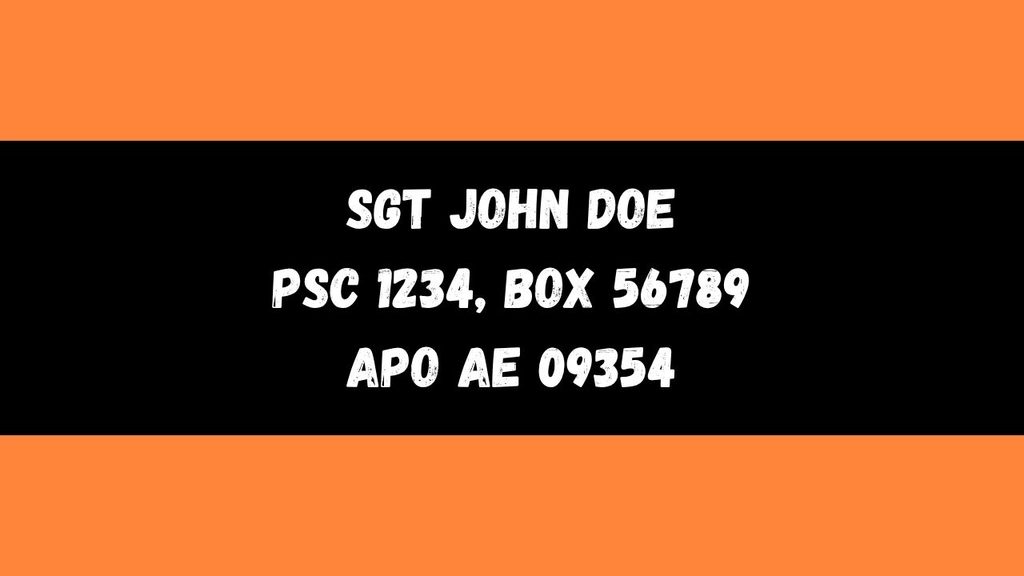
A typical example follows this shape: name first (rank is common but not required), then a unit, PSC, or CMR number with a box number, then the APO, FPO, or DPO tag, the region code, and the ZIP. Something like:
SGT John Doe
PSC 1234, Box 56789
APO AE 09354
No street. No city or country listed anywhere, even though the destination is clearly overseas. It’s tempting to add a foreign city name just to be thorough, but doing that actually causes more problems than it solves since it can push the package down the wrong routing path entirely
The Region Codes
Instead of a state abbreviation, you’ll see one of three region codes:
- AE, which covers Europe along with the Middle East, Africa, and Canada
- AP, for the Pacific
- AA, for the Americas outside of Canada
An address might read “APO AE 09140” or “FPO AP 96601.” Every piece of that string is telling a sorting facility something it needs to know.
And the ZIP Codes Themselves
These don’t follow the logic of regular ZIP codes. Anything starting with 09 usually falls under AE. Numbers in the 962 to 966 range point to AP. A small cluster starting with 340 covers AA. None of them are tied to real land or population, since their only job is routing mail through the military system.
The Shipping Rules That Actually Matter
A few rules apply here that don’t apply to normal domestic shipping. Miss one of them and that’s usually where the delay comes from.
USPS Is the Only One That Can Deliver
This is probably the biggest surprise for people. UPS and FedEx can’t deliver directly to APO, FPO, or DPO addresses, period, because of security restrictions on how military mail gets routed. A handful of carriers get around it by handing the package to USPS partway through the trip, but they ship it purely through a private carrier with no handoff involved, and it’s not going anywhere near its destination.
A Customs Form Is Still Needed
Feels a little backwards, since these addresses are treated as domestic for postage purposes, but a customs form is generally still required. The package really is leaving the country. USPS just handles the pricing side as if it weren’t.
Some Things Just Can’t Be Mailed
Military mail has its own restricted items list, and it’s tighter than what applies to a normal domestic package. Alcohol is basically off the table across the board. Aerosols, flammable liquids, and a handful of other hazardous items are also restricted or outright banned, and the exact rules can shift depending on the destination country, since some countries add their own limits on top of what USPS already restricts. Worth a quick check before mailing anything out of the ordinary rather than assuming it’ll pass through fine.
It’s Going to Take a While
Set expectations early. Priority Mail can take around two and a half weeks to reach an APO or FPO address, while standard economy options take longer. For brands managing global orders, integrating a reliable e-commerce shipping strategy is essential to maintain clear tracking updates and avoid customer friction over extended military transit times.
At Least It’s Not More Expensive
Small silver lining here. Postage still runs at regular domestic rates no matter how far the package is actually traveling. Shipping to a base in Germany costs the same as shipping to a state two hours away.
APO vs FPO vs DPO at a Glance
| Feature | APO | FPO | DPO |
|---|---|---|---|
| Full name | Army Post Office | Everyday shipments with no urgency. Fleet Post Office | Diplomatic Post Office |
| Serves | Army and Air Force personnel | Navy, Marine Corps, Coast Guard | State Department and embassy staff |
| Typical location | Overseas bases and installations | Ships at sea and naval installations | U.S. embassies and consulates |
| Region codes used | AA, AE, AP | AA, AE, AP | AA, AE, AP |
| Carrier restrictions | USPS only | USPS only | USPS only |
| Treated as domestic mail | Yes | Yes | Yes |
| Customs form required | Yes, on most shipments | Yes, on most shipments | Yes, on most shipments |
Where Most People Go Wrong
A small set of mistakes seems to account for most of the delivery problems. Sticking a foreign city or country name on the label somewhere is a common one, and it can send the package into an international customs pipeline instead of the military system it’s supposed to move through. Writing “Any Service Member” instead of a specific name and unit number is another, since these addresses require a named recipient for privacy reasons.
Shipping through a private carrier without checking whether it partners with USPS for the final military leg catches many businesses off guard. Working with an experienced order fulfillment company ensures military and diplomatic orders are routed exclusively through authorized channels without domestic depot drop-offs.

Frequently Asked Question
Here are some frequently asked questions about APO, FPO, and DPO that you should know about:
It’s about who the mail belongs to. APO is for the Army and Air Force, FPO is for the Navy, Marine Corps, and Coast Guard, and DPO is for State Department and embassy staff overseas.
Not on their own. Only USPS can deliver directly to APO, FPO, and DPO addresses. A few carriers hand things off to USPS partway through, but anything shipped entirely through a private carrier usually doesn’t make it.
No. They sit in the state field, but they’re really region codes: AA for the Americas, AE for Europe, the Middle East, Africa, and Canada, AP for the Pacific.
Longer than a regular domestic package. Priority Mail runs about two and a half weeks. Ground Advantage can take six to eight weeks, depending on where it’s headed and the time of year.
⦁ AE (Armed Forces Europe): Covers Europe, the Middle East, Africa, and military installations in Canada.
⦁ AP (Armed Forces Pacific): Covers Japan, South Korea, Australia, and all Pacific-based commands.
⦁ AA (Armed Forces Americas): Covers Central and South America, the Caribbean, and military stations across the Americas outside the contiguous U.S. and Canada.
Although both Europe and the Middle East share the AE regional code, transit times depend on the Military Postal Service Agency’s forward-deployment logistics. Permanent European hubs (like Ramstein Air Base in Germany) have direct cargo flights and sorting centers, often receiving Priority Mail in 7 to 10 days. Remote or forward-operating locations in the Middle East require multiple secondary transport hops and tactical distribution, stretching transit windows to three weeks or longer.
No, it stays at standard domestic rates no matter how far away the destination actually is.
Final Thoughts
Once you break it down, none of this is as confusing as the address format makes it look at first glance. The three-letter code says who the recipient works for, and the region code plus ZIP handle the routing from there. Get the format right, ship through USPS, check the restricted items list, and pad your timeline a little. That covers most of what causes problems with military mail in the first place.