


Most people don’t think twice about how a letter gets from one mailbox to another. Not until the letter actually matters.
A lease notice. A tax document. A demand letter from an attorney. The moment proof becomes as important as delivery, plain postage stops being enough.
That’s where certified mail comes in. It’s one of the oldest “proof” services the United States Postal Service offers, and it’s still the default choice for anyone who needs a paper trail showing a document was sent and received.
This guide breaks down what certified mail actually is, how the process works, what it costs, and how it compares to registered mail, the service people most often confuse it with.
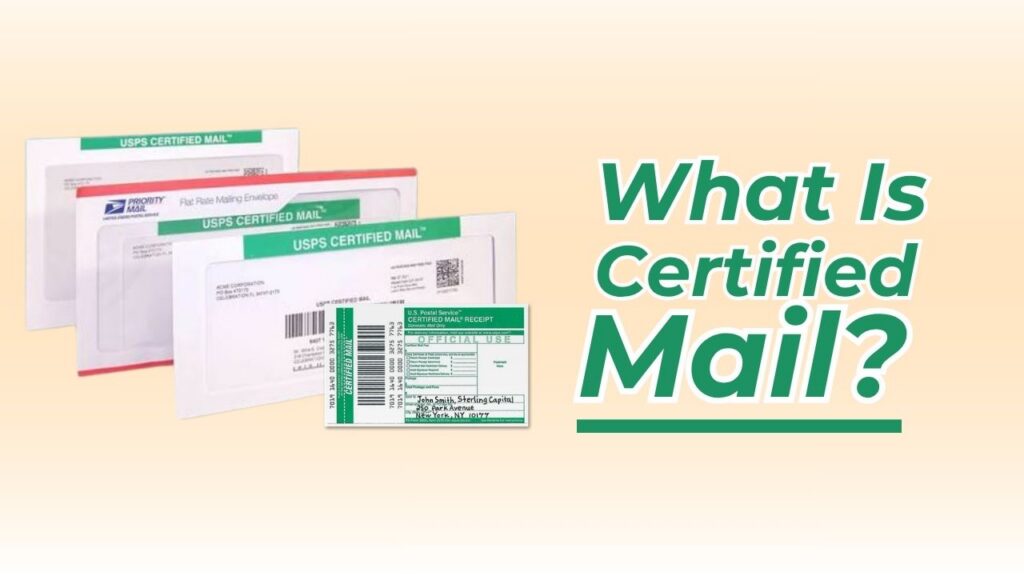
What Is Certified Mail, Exactly?
Certified mail is a USPS add-on service that gives the sender a mailing receipt, a tracking number, and usually a recipient’s signature at delivery. It isn’t a separate class of mail. It rides on top of First Class Mail or Priority Mail, and USPS handles it the same way it handles any other letter in transit. The only real difference is the paperwork attached to it.
USPS outlines this in detail in the official PostalPro Certified Mail guide, noting that Certified Mail provides an official mailing receipt, electronic verification of delivery or attempted delivery, and rides entirely on top of First-Class Mail or Priority Mail.
In other words, it is basically the postal equivalent of getting a verified signature and a timestamp instead of just dropping a letter in the box and crossing your fingers.
Where Certified Mail Came From
Certified mail has been around way longer than most people assume. Historical records from Mystic Stamp Company show that USPS rolled it out on June 6, 1955. It started as a cheaper alternative to registered mail, which had been around since 1855 but had gotten too pricey for everyday use.
Seventy years later, that green return receipt card and PS Form 3800 are still instantly recognizable. Anyone who has ever tangled with the IRS, a stubborn landlord, or a collections agency knows that look immediately.
The service caught on fast because it solved a real problem. Businesses needed a way to prove delivery without paying registered mail prices for every routine notice. Certified mail split the difference, and it’s held that middle ground ever since.
How Certified Mail Works Step by Step

Sending certified mail follows a fairly predictable process, whether you’re mailing one letter or a few hundred a month.
- Fill out PS Form 3800. This is the certified mail slip, usually a small green and white sticker with a barcode. It gets attached to the front of the envelope, above the address.
- Add postage and the certified fee. Certified mail requires standard postage plus a separate certified mail fee. A return receipt (the classic green card, or an electronic version) is optional and priced separately.
- Drop it off or hand it to a carrier. Certified mail can be dropped at a post office counter, handed to a rural carrier, or in some cases left in a collection box. No special counter visit is required for basic certified mail.
- Track it. USPS assigns a unique tracking number, typically starting with 9407, 9208, or 9307, so the sender can watch the letter’s progress online from acceptance to delivery.
- Get proof of delivery. Once delivered, USPS keeps a delivery record on file, including the recipient’s signature, for a set period. If a return receipt was purchased, the sender also gets a signed card or PDF back.
Delivery Timeline
The mail itself moves at First Class speed, usually one to five business days domestically. Certified mail doesn’t travel any faster than a regular letter. It just arrives with documentation attached, which occasionally means a slight delay if no one is home to sign for it.
Why People and Businesses Use Certified Mail
The appeal of certified mail comes down to one thing. It turns “I mailed it” into something you can actually prove later, in front of a judge, an auditor, or a landlord.
- Legal protection. Landlords, attorneys, HR departments, and debt collectors rely on certified mail because many state laws and lease agreements specifically require proof of delivery for a notice to be enforceable.
- Tax and government correspondence. The IRS and state tax agencies use certified mail heavily, and taxpayers often need to respond the same way to build a matching paper trail on their end.
- Affordability compared to the alternative. Certified mail costs a fraction of registered mail while still delivering a signature and a delivery record, which is exactly why it replaced registered mail as the everyday standard back in 1955.
- No special packaging or insurance required. Unlike registered mail, certified mail doesn’t require sealed handling or a declared value, which keeps the process quick and simple.
What Does Certified Mail Cost in 2026?
Certified mail cost has two parts, and it helps to think of them separately. There’s the postage for the letter itself, and there’s the certified mail fee, which is fixed and non-negotiable. As of 2026, the certified fee runs a little over five dollars, on top of First Class postage that starts under a dollar for a standard one-ounce letter. Add an electronic return receipt and the total for a single-page letter typically lands in the $12 to $14 range once everything is combined.
That certified mail cost stays the same no matter what’s inside the envelope, which is one reason businesses that send high volumes of notices (collection letters, lease terminations, compliance documents) build the fee directly into their operating budget instead of treating it as a variable expense. For occasional senders, it’s still cheap enough that cost rarely factors into the decision at all.
Certified Mail vs. Registered Mail
People frequently mix these two up because both involve a signature and a receipt. The real difference comes down to what each one is built to protect. Certified mail provides proof of delivery. Registered mail protects the physical item itself.
Comparison Table
| Feature | Certified Mail | Registered Mail |
| Primary purpose | Proof of mailing and delivery | Maximum security for valuable items |
| Typical fee | Lower, flat add-on fee | Higher fee, scales with declared value |
| Insurance | Not included | Available, with higher coverage limits |
| Delivery speed | First Class speed (1 to 5 business days) | Slower (often 5 to 10 business days) |
| Handling | Moves with regular mail in transit | Locked, logged, and tracked at every transfer point |
| Drop off | Post office, carrier, or mailbox | Post office counter only |
| Best for | Legal notices, tax filings, contracts | Cash, jewelry, irreplaceable documents |
Which One Should You Choose?
If the goal is documenting that something legal or official was sent, certified mail usually wins on cost and speed. If the goal is protecting something physically valuable in transit, registered mail’s chain of custody handling is worth the extra fee and the slower delivery window. Most everyday senders, including landlords, small businesses, and individuals dealing with a dispute, end up choosing certified mail simply because it covers what they actually need.
Common Uses for Certified Mail
Certified mail shows up most often in situations where a missed or disputed delivery could carry real consequences. Common examples include:
- Eviction notices and lease terminations
- IRS and state tax correspondence
- Legal notices, demand letters, and cease and desist letters
- Employment termination or disciplinary documentation
- Insurance claim denials and appeals
- Debt collection notices
In each case, the sender needs more than a stamp. They need something they can point to later if the delivery is ever questioned in a dispute or a courtroom.
Limitations of Certified Mail
Certified mail isn’t a perfect fit for everything, and it helps to know where it falls short before relying on it.
Certified Mail only covers domestic USPS delivery points. For operations shipping beyond basic envelopes or navigating commercial carrier choices, evaluating standard shipping transit times and carrier options is crucial to finding the right balance of speed, tracking visibility, and parcel handling.

Frequently Asked Questions
Here are some frequently asked questions about certified mail that you should know about:
Certified mail is used any time a sender needs documented proof that a letter was mailed and delivered. Most commonly, that means legal notices, tax documents, lease-related letters, and other correspondence where delivery might later be disputed.
Certified mail cost includes the USPS certified fee, which runs a little over five dollars, plus regular postage. Adding an electronic return receipt typically brings a one-page letter to around $12 to $14 total.
Yes. The recipient, or anyone authorized to accept mail at that address, must sign upon delivery. USPS keeps that delivery record on file for a set period after the letter arrives.
Certified mail travels at standard First Class Mail speed, generally one to five business days domestically. The certified service adds documentation, not delivery speed.
No. Certified mail vs. registered mail comes down to purpose. Certified mail proves a letter was delivered, while registered mail is built to physically protect valuable items with locked, logged handling at every step. Registered mail also costs more and moves more slowly.
Yes. Certified Mail is available to all domestic addresses across the 50 states, Puerto Rico, Guam, the U.S. Virgin Islands, and American Samoa. However, while mainland transit typically takes 1 to 5 business days, shipments to non-contiguous states and offshore territories often experience longer delivery windows due to air and barge schedules.
Certified Mail cannot be sent to foreign countries; international senders must use Registered Mail International for proof of delivery. It can, however, be sent to military APO, FPO, and DPO locations, though physical delivery confirmation and electronic signature availability may vary depending on local overseas military command policies.
Yes. Every certified mail piece gets a unique tracking number that can be checked online, letting the sender confirm exactly when the letter was delivered or when a delivery attempt was made.
Final Thoughts
Certified mail exists for one reason. Some letters can’t afford to just disappear into the mail stream without a trace. Whether it’s a legal notice, a tax filing, or a lease document, the small added fee buys something plain postage never could: a verifiable record that the letter was sent, and proof of exactly when it landed in someone’s hands. For anything where “I mailed it” needs to hold up later, certified mail is still the simplest way to make that claim stick.