


Take a walk through an industrial logistics park outside Shenzhen or Ningbo, and you’ll see row after row of massive concrete warehouses that look basically identical from the road.
Step inside, though, and they operate under two totally different legal setups. One is fenced off with round-the-clock digital customs cameras watching the loading bays. The building right across the street runs like any standard storage unit you’d rent anywhere in the world.
That split is basically the whole bonded vs. non-bonded warehouse debate. Mix the two up, and you end up either handing over thousands in import duties you didn’t need to pay yet, or having local customs freeze a shipment because you opened a box without asking permission first.
Here’s the practical breakdown: what each warehouse actually does, where the whole bonded concept came from in China, how daily handling works, and when a brand genuinely needs one over the other.
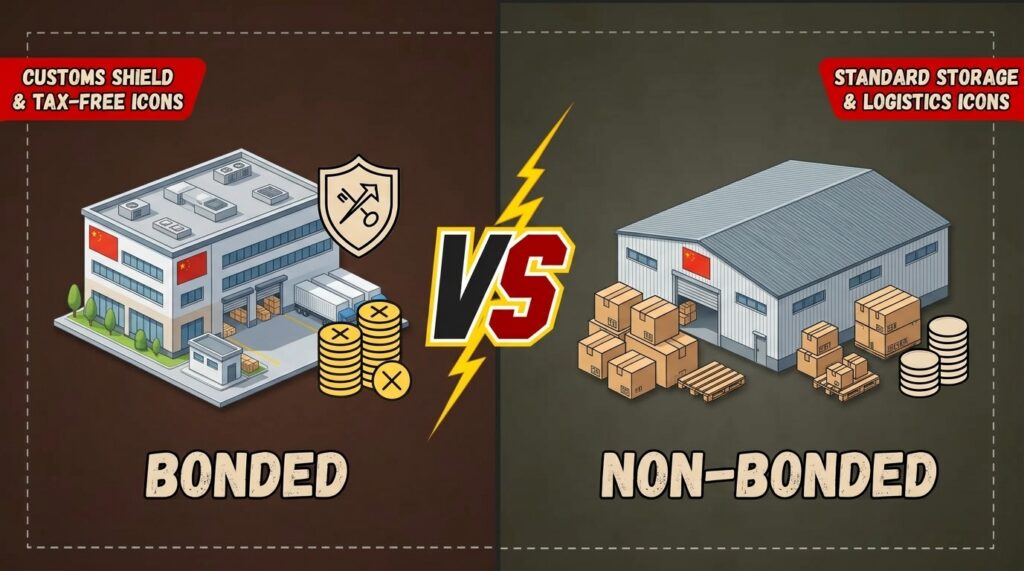
What Is a Bonded Warehouse in China?
A bonded warehouse in China is a specialized storage facility supervised directly by Chinese customs authorities, officially known as the General Administration of Customs.
The main thing to understand here is “duty-deferred status.” When your goods arrive at a Chinese port and move into a bonded facility, they haven’t technically entered the domestic Chinese market yet from a tax perspective. That means you don’t pay import tariffs, value-added tax (VAT), or consumption taxes at the border. Those fees sit on pause until the product actually leaves the warehouse gate to go to a local buyer, or gets loaded onto another ship to head to a different country entirely.
It’s essentially a cash flow tool. If you bring in an entire shipping container of high-end skincare or electronics, paying 20% or 30% in taxes on the whole lot upfront hurts your bottom line. Storing in a bonded facility lets you pay those taxes piece by piece, only as items actually sell.
Where China’s Bonded Warehouse System Came From
The setup isn’t a new creation. China’s bonded warehousing network grew directly out of its shift toward becoming an export powerhouse back in the late twentieth century.
Customs trade history records track modern Chinese bonded zones back to 1990, when the Chinese government established the Waigaoqiao Free Trade Zone in Shanghai. Back then, these areas were built almost entirely for manufacturing components and raw materials under what officials called “processing trade.” A factory would bring in copper or microchips tax-free, assemble a radio or a toy, and export it right back out without ever tangling with local import duties.
Over the last thirty years, customs updated those original zones into what are now called Comprehensive Bonded Zones. Today, instead of just raw steel and plastic pellets, these facilities handle millions of direct-to-consumer e-commerce orders for international brands trying to sell to Asian consumers without setting up an entire legal entity on the ground.
What Is a Non-Bonded Warehouse in China?
A non-bonded warehouse is simply a regular commercial storage building. It’s not monitored by customs officers, it doesn’t need special customs network integrations, and it follows normal local business rules.
If you import goods from outside China into a non-bonded warehouse, you have to pay every cent of import duty and VAT at the port before the truck can even leave the dock. Once the goods are through the gate and sitting on the shelves, though, they’re in “free circulation.”
That freedom is the whole point. You don’t have to report to anyone if you want to open up cartons, bundle two items together, throw in a printed thank-you card, or swap out a damaged box. For companies manufacturing products inside China for overseas buyers, a non-bonded warehouse is almost always the standard choice because there are no import taxes to dodge in the first place.
The Big Differences That Actually Matter in Day-to-Day Operations
Strip away the legal jargon and the comparison comes down to a few very specific operational rules:
Customs Timing and Cash Flow
In a bonded facility, taxes wait until an order is placed. In a non-bonded facility, taxes are paid upfront at the port. If you’re holding expensive stock that moves slowly, bonded saves your cash flow. If your inventory turns over every two weeks, the tax deferral benefit doesn’t matter nearly as much.
What You Can Actually Do to the Box
Non-bonded warehouses give you complete freedom. You can kit items, label them, repackage them, or fix broken tags whenever you want. Bonded warehouses are strict. You cannot just alter, assemble, or open products inside a bonded zone without specific customs approvals. Mess with the contents unauthorized, and customs treats it as smuggling or inventory fraud.
How Long Goods Can Sit
A non-bonded warehouse lets you keep inventory on a pallet for five years if you’re willing to pay the storage rent. Bonded warehouses have a clock ticking. Most bonded inventory has a legal limit, typically one to two years depending on the zone. Before you’re legally required to either pay the duties, export the stock out of the country, or apply for a formal extension.
Building out a sustainable supply chain means figuring out how these storage models affect shipping times and overhead costs. Taking a close look at how warehousing in China works across both setups makes it a lot easier to choose the right footprint before signing a long-term lease.
Bonded vs Non-Bonded Warehouse in China at a Glance
| Feature | Bonded Warehouse | Non-Bonded Warehouse |
| Supervising Body | General Administration of Customs (GACC) | Local commercial & municipal rules |
| Duty & VAT Payment | Deferred until product leaves the zone | Paid immediately upon arrival at port |
| Main Advantage | Cash flow protection & tax deferral | Total freedom to repack, kit, and bundle |
| Handling Limits | Strict rules against altering contents | Zero restrictions on assembly or kitting |
| Storage Time Limit | Usually 1 to 2 years (requires extension) | Unlimited (as long as rent is paid) |
| Best For | High-value imports, Asia re-export, CBEC | DTC order fulfillment, locally made goods |
| Paperwork Load | Heavy (direct customs API reporting) | Standard warehouse management system (WMS) |
When to Choose a Bonded Warehouse
Bonded warehousing earns its higher administrative hassle in a few specific situations:
- Selling into China via Cross-Border Ecommerce (CBEC): If you’re a foreign brand selling beauty products or vitamins to Chinese shoppers, stocking them in a bonded warehouse lets local buyers receive their orders in two or three days while benefiting from lower consumer import tax rates.
- Re-exporting Stock Across the Asia-Pacific Region: If you use China as a central hub to ship out parcels to Japan, Australia, Singapore, and South Korea, bonded storage lets you hold that inventory near Asian shipping routes without paying Chinese customs taxes on items that aren’t even staying in the country.
- Carrying High-Value, High-Tariff Products: If your goods get hit with a 30% or 40% combined duty and VAT rate, letting that tax bill sit deferred until the moment of sale keeps that cash in your bank account.
When to Choose a Non-Bonded Warehouse
For the vast majority of ecommerce sellers manufacturing goods in China to ship to buyers in the West, non-bonded is the obvious answer:
- Direct-to-Consumer (DTC) Global Shipping: If your factory is in Dongguan and your customers are in the US, UK, and Europe, moving goods into a non-bonded facility allows your team to pick, pack, and fly parcels out without customs bureaucracy holding up daily dispatches
- Complex Kitting, Bundling, and Custom Packaging: If your fulfillment process involves putting three products into a branded box, adding custom tissue paper, or swapping localized instruction manuals, non-bonded warehouses let workers do that instantly.
- Locally Sourced Inventory: If the goods were manufactured inside China, they are already cleared domestically. Putting domestic goods into a bonded zone just adds paperwork for no financial benefit.
Pairing your warehouse setup with an experienced freight forwarding network makes moving goods between factory floors, regional sorting hubs, and export terminals a lot smoother when shipping deadlines get tight.

Frequently Asked Questions
Here are some frequently asked questions about bonded vs. non-bonded warehouses in China that you should know about:
It comes down to tax timing. A bonded warehouse holds products under customs supervision with all import tariffs and taxes deferred until the goods leave the facility. A non-bonded warehouse holds products that have already had all duties settled upfront, or domestic products that never required customs clearance to begin with.
Only in very limited ways. Designated Comprehensive Bonded Zones may allow basic relabeling or simple outer-carton changes, but assembly, kitting, or opening product seals without prior customs approval is strictly prohibited. If your order fulfillment requires custom bundling, a non-bonded facility is far more practical.
Clearance speed depends heavily on which port and province you use. Tier-one coastal hubs like Shanghai Waigaoqiao, Shenzhen Qianhai, and Ningbo run automated customs green channels that clear approved parcels in just a few hours. Smaller inland bonded zones can take a couple of days because fewer cargo flights and customs staff are available to process clearances.
Hong Kong functions as a free port and a separate customs territory from mainland China. Because general consumer goods enter Hong Kong duty-free anyway, standard warehouses there already operate with the tax-free benefits of a bonded zone without the heavy mainland customs paperwork. Mainland China, on the other hand, enforces strict import taxes, which is why formal bonded facilities are necessary there.
Yes. Unlike non-bonded warehouses where you can store items indefinitely, bonded inventory in China is generally capped at one to two years depending on the specific zone’s regulations. Once that deadline hits, you must either clear the goods for local sale, re-export them out of China, or file for a formal administrative extension.
Final Thoughts
Picking between a bonded and non-bonded warehouse in China isn’t about which one sounds more prestigious. It’s about where your products come from and who’s buying them. If you’re importing foreign goods into China or running a regional Asia-Pacific distribution hub, a bonded warehouse saves serious cash on duties. If you’re making products in China to sell directly to shoppers across the globe, a non-bonded warehouse gives you the freedom to pack, kit, and ship without customs officers looking over your shoulder. Match the warehouse to your actual sales channel, and you avoid the headaches before the first container even docks.