


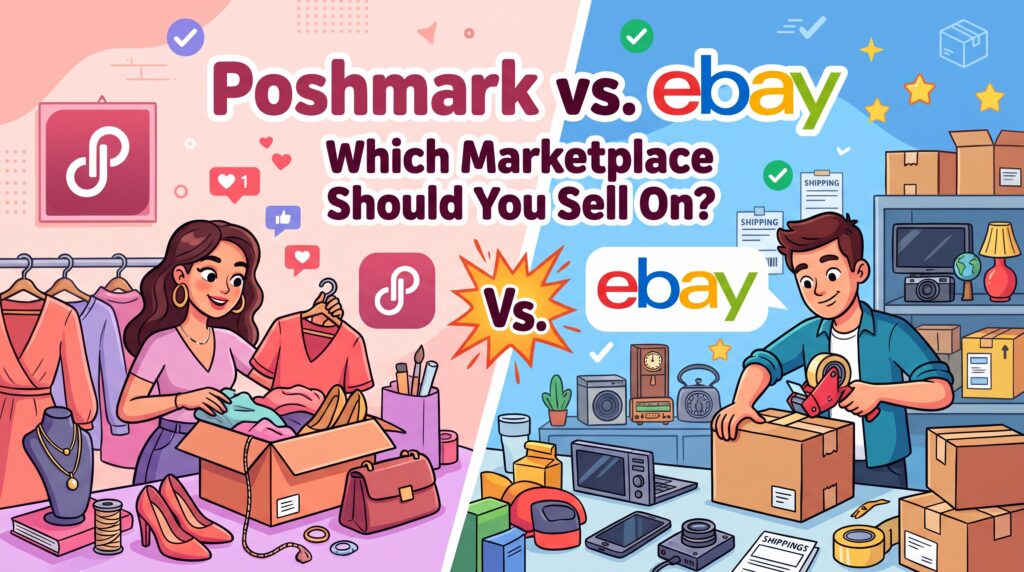
The same denim jacket, the same photos, the same price, listed on both Poshmark and eBay one weekend. One sold within hours; the other sat dead for three weeks. The jacket did not change. The buyers did. That is really all you need to understand about these two platforms, and it is why “which is better” is the wrong question. The right question is which one people who want your stuff use, and whether you can stand the specific kind of grind each one puts you through.
Where They Came From
The backstory matters because it explains why selling on each feels so different. Not the full corporate timeline, just enough to get it.
Poshmark Began as a Closet
Manish Chandra launched Poshmark in 2011. The idea was simple: buying clothes from your phone should feel like flipping through a friend’s closet. Scroll, follow sellers you like, share stuff around. It worked. The company went public in January 2021. Then in 2023, Naver, the South Korean tech company, bought the whole thing for $1.2 billion, which is a staggering amount for used clothes and says everything about how big secondhand fashion has become.
Over 80 million accounts are on there now, and they are not browsing for phone chargers. They want brands and outfits and the little thrill of talking someone down five bucks.
eBay Began as an Experiment
Back in 1995, Pierre Omidyar put up AuctionWeb basically to see what happens. The first thing that sold was a broken laser pointer for $14.83, and someone actually paid that. The site became eBay in 1997, went public in 1998, and never bothered narrowing down. Which is why right now, today, you have auctions running next to fixed-price listings, collectors hunting discontinued parts, resellers flipping electronics, and people who live for the final ten seconds of a bid. All on the same search bar. It is chaos, but it is the kind of chaos that moves inventory.
How the Fees Compare
This is where people get vague, so here are the actual numbers.
What Poshmark Takes
Poshmark takes 20% on $15 and up, with a flat $2.95 below that. The structure is simple, almost too simple, because that flat fee murders cheap listings when $2.95 out of a $10 sale removes nearly a third of your money before you have done anything. Anyone selling low-priced items needs to see this Poshmark selling fees guide from Vendoo, which lays out more price points.
What eBay Takes
Roughly 13.6% plus $0.40 per order in most categories, no store needed. Plus 250 free listings a month, then $0.35 each after. If you list twenty things a month, you will never think about that cap. If you list two thousand, it is a line item in your budget. Categories have their own quirks too, so check this rundown of eBay selling fees before you lock prices in.
Same Items, Different Damage
Take a $10 shirt as an example. Poshmark takes $2.95, and you keep $7.05, while eBay takes about $1.76 and you keep $8.24. At $50: $10 vs. around $7.20. At $100: $80 vs. about $86. Now, the eBay numbers do not include shipping, which you pay yourself there, so do not treat these as exact. But the trend is obvious, and it gets worse for Poshmark as prices go up. That 20% starts to feel like a lot when you are selling a $200 coat.
Poshmark vs eBay at a Glance
| Factor | Poshmark | eBay |
| Started | 2011, Manish Chandra | 1995, Pierre Omidyar as AuctionWeb |
| Audience | Fashion buyers, 80M+ accounts | Global, every category |
| Seller fee | 20% on $15+, $2.95 flat below | ~13.6% + $0.40 per order |
| Listing cost | Included | 250 free/month, then $0.35 each |
| Sale format | Fixed price, likes, offers | Auctions + fixed price |
| Shipping | Prepaid label, buyer pays, 5 lbs | All on you |
| Daily grind | Social: shares, parties, closets | Listings, pricing, parcels |
| Best for | Fashion, beginners | Rare items, thin margins |
Shipping Decides Your Week
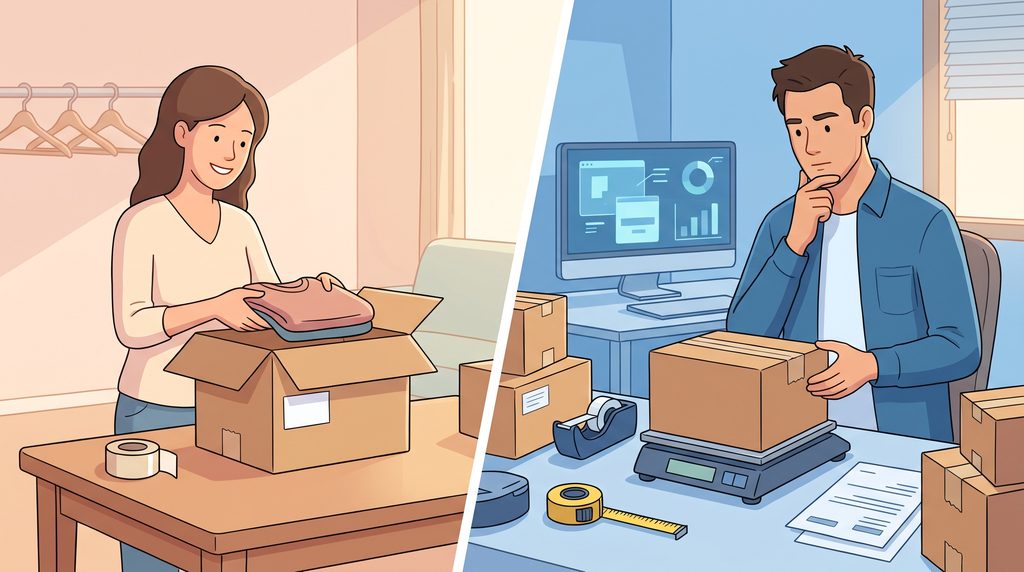
Poshmark sends a label; the buyer already paid for it, it covers five pounds, and you pack and drop off. eBay makes you pick the carrier, set the price, and buy the label yourself. Guess a weight wrong, and it comes out of your margin. And you will guess wrong. Everyone does, usually in the first month.
Some people will happily give Poshmark 20% just to never look at a shipping calculator, which is fair enough. Other people sell heavy stuff where eBay’s flexibility saves serious money, so it depends on what you are moving. Once you are past a few parcels a week, though, understanding e-commerce shipping stops being optional. Small postage errors add up fast when you are doing volume.
Which One Fits You
Look at your inventory before your preferences. The inventory decides.
When Poshmark Is the Answer
If you sell clothes, shoes, and accessories, the buyers are already there, and they are specifically there for fashion. Trendy stuff and designer pieces move faster on Poshmark than anywhere. It also rewards showing up daily. Share your closet, hit the Posh Parties, answer offers. Do it consistently and you pull ahead of everyone who lists and disappears. Beginners get the easiest start here too. No shipping to figure out, no settings to break.
When eBay Is the Answer
Your stuff is not fashion. Electronics, collectibles, auto parts, weird niche things. eBay’s audience is huge and worldwide, and auctions let buyers tell you what rare items are worth instead of you guessing. Fees are lower on most things over $15, which matters a lot when margins are thin. Oh, and if you are outside the US and Canada, Poshmark is not even an option, so the decision is made for you.
A lot of sellers do both. List everywhere; whoever buys first wins. One rule, and it is non-negotiable: the instant something sells on one site, kill the other listing immediately. A double sale means a cancelled order, and a cancelled order means a buyer who tells people. That costs more than any fee. Once you are spending evenings just keeping track, look at e-commerce fulfillment. It stops being a luxury around then.
Mistakes That Cost Real Money
Listing $5 items on Poshmark without checking the fee first. $2.95 flat on a $5 sale. Do the math. New sellers figure this out after weeks of work that earned them almost nothing.
Thinking Poshmark is passive. It is not. Dead closets do not sell. The sellers making money are on there every day sharing and engaging. If you cannot do that, adjust your expectations.
Forgetting eBay shipping is 100% yours. Weigh everything. Measure everything. Decide before you list whether shipping is baked into the price or charged separately. Skip this step and watch your margins leak for months.
Cross-listing without a removal system is asking for trouble. One double sale does more damage than a slow month, so until you can delist in minutes, stick to one platform.

Frequently Asked Questions
Poshmark, for clothes. The prepaid label and simple fee mean fewer ways to screw up early on. eBay wants more from you on day one- pricing, shipping, and all of it- but it opens way more categories once you are comfortable.
eBay, on anything $15+. That 13.6% plus $0.40 beats 20% flat. Under $15, you have to run your own numbers, and do not forget eBay makes you pay shipping.
20% at $15 and up; $2.95 flat below. The buyer pays shipping through the prepaid label.
250 a month, no store needed. Then $0.35 each. Most people never hit it. High-volume sellers think about it constantly.
Poshmark: the buyer, via prepaid label, up to 5 lbs. eBay: you. All of it.
Yes, and tons of sellers do it. Just delete the other listing when the second one sells, or you will get burned.
Fashion on Poshmark, obviously; that is the whole culture there. eBay for everything else, especially rare stuff where auctions let the market set the price.
When you spend more time packing and shipping than sourcing and listing. Before that point, the built-in tools are fine.
Final Thoughts
Fashion plus daily effort goes to Poshmark. Weird items, thin margins, or buyers overseas go to eBay. Most serious sellers end up using both eventually, Poshmark for clothes and eBay for the rest. It only works if you delist instantly and do honest math on every sale after fees and shipping. Pick one, get good at it, add the second when you can handle it.