


Shipping golf clubs safely comes down to three decisions: what the clubs travel in, how they’re cushioned, and which carrier service moves them. Ground delivery is enough for most trips, so the real money and risk come down to packing. A bent shaft or a cracked clubhead can ruin a cheap shipment just as easily as an expensive one.
This guide covers how to pack golf clubs, the steps from label to doorstep, what drives the price, and which service fits which situation.

How Does Shipping Golf Clubs Work?
Shipping golf clubs follows the same path as any parcel. You protect the equipment, put it in a carrier-acceptable container, attach a label, and hand it off via drop-off or scheduled pickup. The difference is shape. Clubs are long, narrow, and fragile at both ends, so they behave nothing like a shoebox.
What you’re sending changes the setup:
- One club or a few clubs usually fit in a narrow, tube-style box.
- A full set without a bag can fit in that same tube, or in a larger carton if the clubs are bundled and padded.
- A complete golf bag needs a box made for the whole bag, or a hard-shell travel case.
- You can ship clubs in a hard case, though carriers may charge extra to accept it.
FedEx offers speciality boxes for these shapes: one large enough for an entire golf bag and a narrower tube-style option for individual clubs. Carriers generally price based on package dimensions and weight, so an oversized carton adds cost even when the contents are light.
How to Pack Golf Clubs for Shipping
Gather the Right Packing Materials
You’ll need a golf club shipping box or another suitable corrugated carton, bubble wrap or inflatable air cushioning, padded paper or similar void fill, headcovers, and pressure-sensitive packing tape. If you ship clubs often, it’s worth buying an aluminium support rod. FedEx recommends one because the tallest club in a bag absorbs the most force in transit.
Protect Club Heads and Shafts
FedEx recommends removing driver and fairway wood heads before sealing the box. Mark each head’s position first, so reassembly is easy. Then put headcovers on every club, whether you detached the head or not, to avoid nicks and dents.
Next, wrap each club in bubble wrap, tape the wrap in place, and bundle the clubs together. Bundled clubs hold up better than loose ones and don’t rub against each other.
Choose the Right Box or Travel Case
A speciality box costs less to buy, but its protection depends entirely on your cushioning. A hard-shell case provides rigid protection and, according to FedEx, doesn’t need a corrugated container. The trade-off is an added fee and a tie-on tag for attaching a shipping label. Shipping golf clubs in a travel case is easier to pack but costs more to send.
If you need to ship golf clubs without a golf bag, the narrow tube-style box is built for exactly that.
Space is the enemy. FedEx’s rule of thumb is about two inches of cushioning around the bag, plus one or two inches at the bottom before the bag goes in. Fill any remaining gaps with bubble wrap, inflatable air cushioning, or padded paper, then shake the box gently to confirm nothing shifts.
Seal and Label the Package
Close the box with plastic packing tape using the H-tape method: at least three strips across the top and bottom, then tape every seam and flap. Remove or fully cover any old shipping labels so scanners read only the new one. For a hard case, put the label on the tie-on tag.
If you’d rather not pack the clubs yourself, FedEx Office offers packing help, and so do participating The UPS Store locations. The UPS Store’s Pack & Ship Guarantee comes with conditions. It describes coverage for UPS shipments only, so don’t assume other carriers qualify. A participating location must pack the clubs using new materials bought there and ship them on the store’s own UPS account. If the shipment is then lost or damaged, reimbursement can cover item value up to its declared value, packing materials and services, and shipping fees (excluding declared value charges).
It does not cover customer-packed boxes, shipments processed through UPS.com or your own UPS account, packaging supplied free by a carrier, or items a carrier restricts. Without purchased declared value, item reimbursement tops out at $100. Confirm current eligibility and terms with your participating store before you ship.
Step-by-Step: How to Ship Golf Clubs
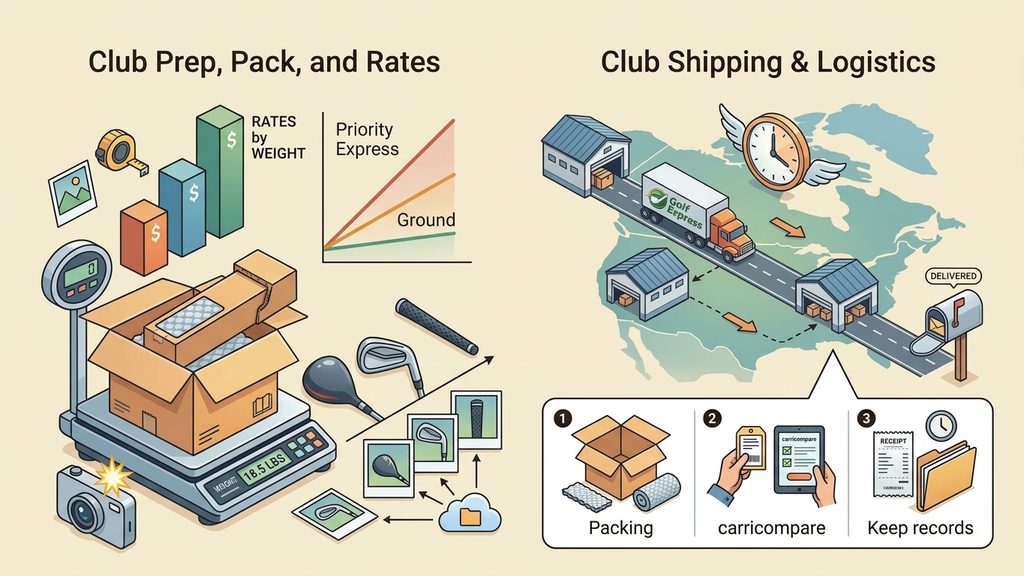
- Inspect and photograph the clubs. Capture the condition of each head, shaft, and grip. These photos matter if you ever file a claim.
- Pack and measure. Pack as described above, then measure and weigh the finished package, including the box and padding.
- Pick a service. Ground works when you have a few days of slack. Expedited services make sense when the clubs must arrive before a specific date.
- Get a quote and buy the label. Enter the packed dimensions and weight, and compare the same service level across carriers.
- Drop off or schedule pickup. Check cutoff times to ensure the shipment ships the same day.
- Keep your records. Save the tracking number, receipt, photos, and any declared-value paperwork.
How Much Does Shipping Golf Clubs Cost?
There’s no flat price. The honest answer is that shipping golf clubs depends on the box, the route, and the speed, and only a live quote reflects all three.
Factors That Affect the Price
- Origin and destination. Longer routes cross more shipping zones and cost more.
- Packed weight and dimensions. A long, lightweight box can be billed by size rather than actual weight, and golf bag cartons are big.
- Delivery speed. Faster services cost more than ground.
- Residential delivery and extras. Home delivery, declared value, pickup, and packing services can each add to the total.
How to Reduce Shipping Costs
The cheapest way to ship golf clubs is usually a snug, well-padded box sent by ground service, but that is a starting point, not a promise. Golf club shipping rates vary by carrier, change over time, and shift with surcharges, so last season’s quote may not hold. Compare live quotes from multiple carriers for the same package.
A few habits help: avoid a box much bigger than what’s inside, choose ground when the calendar allows, and price a carrier’s packing service against your own materials and time.
Best Shipping Options for Golf Clubs
Standard Ground Shipping
FedEx says its Ground service delivers within 1 to 5 business days anywhere in the U.S., and 3 to 7 business days for Alaska and Hawaii.
Expedited Shipping
When clubs need to arrive by a certain day, FedEx offers SameDay, 2Day, and Standard Overnight as faster options. These cost more, so reserve them for fixed dates.
Hard-Shell Golf Travel Cases
A hard case gives rigid outer protection and skips the corrugated box. It suits valuable sets and clubs that travel often.
International Shipping
Shipping golf clubs internationally adds paperwork and cost. According to FedEx, almost every shipment that crosses a border is assessed for duties and taxes, using the shipping label and commercial invoice. The amount depends on factors like product value, country of manufacture, and the destination’s regulations. You choose who pays on the label, and if nobody is selected, the recipient is the default. Check the destination country’s import rules before you book.
Shipping Options Compared
| Shipping option | Protection | Cost considerations | Best use case |
|---|---|---|---|
| Speciality golf club box | Depends on your packing and cushioning | Cost of the box and padding | Complete sets or loose clubs |
| Hard-shell travel case | Rigid outer protection | Case cost plus a possible added carrier fee | Travel and valuable equipment |
| Ground parcel service | Depends on packaging | Compare packed weight, dimensions, and route | Routine domestic shipments |
| Expedited parcel service | Depends on packaging | Higher service cost | Time-sensitive deliveries |
| International parcel service | Depends on packaging and route | Transport, customs, and possible duties | Cross-border shipments |
Shipping Golf Clubs for Different Situations
Selling used clubs online. Buyers expect clubs to arrive intact, so pack them well. Weigh and measure the box before listing so shipping charges are accurate.
Shipping golf clubs to another state. The process is the same, but the zone, and often the cost, change. Ground still covers the U.S. within the FedEx window above.
Sending clubs to a tournament or resort. Before shipping golf clubs to a golf course, hotel, or club, confirm that the destination accepts and holds packages. Ask for a receiving name, add your arrival date to the label, and allow extra time beyond the stated transit time.
Moving house. Many people ship the clubs instead of loading them in a crowded car, and ground shipping works when you have a week of flexibility.
High-value or collectable equipment. Use a hard case or heavy double-box packing, photograph everything, and buy declared value that matches what the set is worth. Coverage terms and exclusions apply, so insurance isn’t a substitute for good packing.
Common Golf Club Shipping Mistakes
- Too much space. Clubs that can slide will hit the box walls.
- Letting heads or shafts move. Unwrapped, unbundled clubs rub, dent, and bend.
- Skipping the dimension check. Confirm the box fits the carrier’s size rules before buying the label.
- Understating packed weight. Measured differences can lead to billing adjustments.
- Assuming insurance covers everything. Carrier coverage has terms and exclusions.
Shipping Golf Clubs for an Ecommerce Business
Selling clubs or accessories online turns a one-off shipment into a repeatable process. Golf equipment shipping has its own quirks: long cartons, fragile ends, and returns that arrive in worse shape than they left. Standard box sizes, clear SKU labels, and photos of outbound packs reduce both damage and disputes.
As volume grows, a fulfilment partner can take over warehouse work and returns so you don’t have to box orders yourself. NextSmartShip runs four U.S. fulfilment centres in Houston, Perth Amboy, Commerce, and Rancho Cucamonga. Brands send inventory in, and the team stores it, picks and packs each order, and gets it on its way.
When stock is spread across several sites, order routing chooses which one fills each order, aiming for the shortest zone and transit distance. For golf clubs, that matters, since a closer destination can cut the price of a long, heavy box. Orders placed before 5 PM go out the same day. A well-run pick-and-pack fulfilment process keeps packaging consistent from order to order.

Frequently Asked Questions
A well-fitted box sent by ground service is usually the lowest-cost route, but no carrier is cheapest for every shipment. Compare live quotes for the same package.
It depends on packed weight, box dimensions, distance, speed, and extras like declared value. Get quotes from each carrier using your measured package.
Yes. A narrow tube-style box is designed for individual clubs or a small number of clubs. Wrap each club, bundle them together, and pad both ends so nothing shifts.
FedEx recommends removing the heads from drivers and fairway woods before sealing the box. Mark their positions first and cover the heads with headcovers or bubble wrap.
Yes. According to FedEx, a hard case doesn’t need an extra corrugated box, but it carries an additional fee and needs a tie-on tag for the label.
FedEx Ground delivers within 1 to 5 business days in the U.S., or 3 to 7 business days for Alaska and Hawaii. Faster services are available when you need a firm date.
It’s possible, but duties, taxes, and import rules depend on the destination. Decide who pays them on the label and check the destination’s rules before booking.