


Pull up almost any product listing in an inventory system, and you’ll usually spot two different codes sitting next to each other. One looks custom, like something a warehouse manager typed up on the spot.
The other is a clean, uniform string of twelve digits that looks the same no matter which store you’re in. That’s basically SKU vs UPC in a nutshell, though the practical differences run deeper than they first appear.
Mixing these two up causes more trouble than people expect. Inventory counts start drifting. Marketplace listings fail to sync correctly. Multi-channel selling turns into a mess that’s annoying to untangle once it’s already happened. So here’s the real breakdown: what each code actually is, who creates it, where the UPC came from historically, and when a business needs one, the other, or both at once.
What Is a SKU?
A stock-keeping unit, or SKU, is a code a business builds for itself to track a specific product or product variant internally.
Nobody hands it down from an outside authority. There’s no registry, no application process, no governing body checking it for accuracy. A company just decides on a system and runs with it, which is exactly why two businesses selling the identical product will almost always end up with two completely different SKUs for it.
What a SKU Actually Looks Like
Most SKUs blend letters and numbers to pack in shorthand about the product’s key details. Take a large black cotton T-shirt. A retailer might code it as TS-L-BLK-COT, with each chunk standing in for a different attribute: shirt style, size, color, material. Length isn’t standardized either.
Some companies keep SKUs tight, four or five characters, so warehouse staff can read and enter them quickly without fumbling. Others stretch them out to forty characters or more, folding in a release date, a warehouse bin location, or a supplier code. Neither approach is wrong. It really just depends on how granular the operation needs to be and how many people are typing these codes by hand every day.
Why Businesses Bother With SKUs At All
The whole point of a SKU system is control over the messy internal side of running a business. Warehouse teams rely on them for picking accuracy, since grabbing the wrong item off a shelf because two products looked alike is a real, common problem. Customer service reps use SKUs to pull up the exact variant a customer is asking about. Inventory software leans on them constantly, tracking what’s moving fast, what’s sitting dead on a shelf, and what needs to be reordered before it runs out completely.
What Is a UPC?
A Universal Product Code, or UPC, solves an entirely different problem, and that difference is really the whole key to understanding SKU vs UPC. A UPC is a standardized twelve-digit barcode that identifies a specific product consistently, everywhere it’s sold, regardless of retailer. Nobody gets to invent one on their own. UPCs are administered through official GS1 standards and barcode guidelines, ensuring that once assigned, that twelve-digit number stays locked to the product across the entire global retail ecosystem.
A can of soda carries the exact same UPC whether it’s sitting on a shelf in a small town grocery store or scanning through a self-checkout kiosk a thousand miles away. That consistency is the entire reason retailers and manufacturers rely on it. It’s not a convenience feature. It’s the backbone that makes modern inventory tracking and point-of-sale scanning possible at scale.
Where the UPC Actually Came From
This isn’t a system that has always existed either. GS1’s own historical records trace the barcode concept back to 1973, when leaders in the U.S. grocery industry developed it specifically to speed up checkout lines that were getting longer as supermarkets grew. The Uniform Code Council was appointed the following year to administer the new standard, and the very first product ever scanned with a UPC was, famously, a pack of Wrigley’s chewing gum, rung up at a Marsh supermarket in Troy, Ohio, on June 26, 1974. That single beep is generally treated as the moment modern retail checkout, as we know it, actually began.
How a UPC Is Actually Built
A UPC isn’t just a random twelve-digit string either. It’s built from specific parts. The first several digits form a company prefix, assigned by GS1 to a specific manufacturer or brand and used across every product that company sells. The next set of digits is an item reference number, which the company assigns itself to distinguish between its own individual products.
The final digit is a check digit, calculated mathematically from everything before it, which scanners use to confirm the code was read correctly. Technically, a UPC is one specific version of a broader identifier called a GTIN, or Global Trade Item Number, the umbrella term GS1 uses for all of its standardized product codes. In North America, the twelve-digit UPC-A format is simply the version almost everyone ends up dealing with day-to-day
The Core Difference Between SKU and UPC
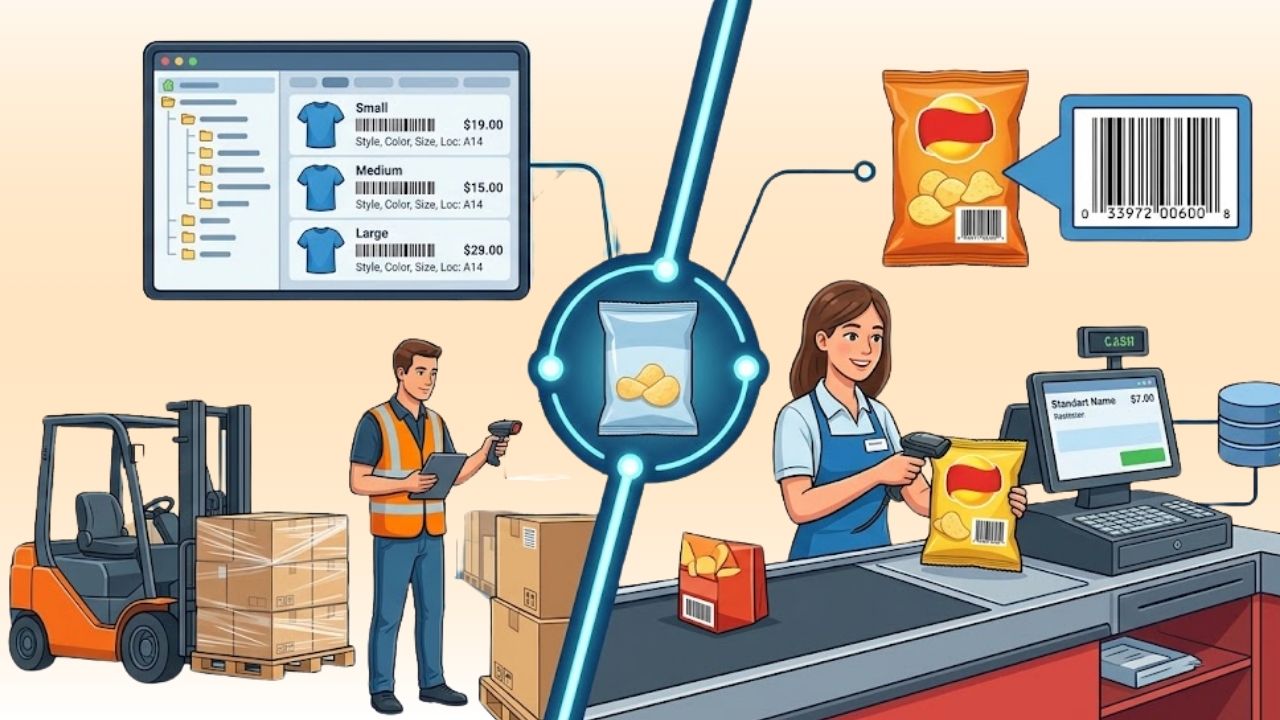
Strip away the details, and it comes down to ownership and scope. A SKU is internal, flexible, and created entirely by one business for its own purposes. A UPC is external, standardized, and shared across an entire supply chain, from manufacturer to distributor to whoever’s scanning it at the register.
Put another way: a UPC identifies what a product is. A SKU identifies how one particular business chooses to track that product internally. That distinction also explains why a single UPC can end up attached to several completely different SKUs across different sellers, since every company builds its own internal system independently, even when they’re all selling the same item.
SKU vs UPC at a Glance
| Feature | SKU | UPC |
| Created by | The individual business | GS1, a global standards organization |
| Format | Alphanumeric, flexible length | Fixed 12-digit number |
| Consistency across sellers | Varies, always different | Identical everywhere |
| Purpose | Internal inventory tracking | External product identification |
| Requires registration | No | Yes, through GS1 |
| Typical use | Warehouse picking, stock counts, POS systems | Retail scanning, supply chain tracking |
| Cost to obtain | Free, self-assigned | Requires GS1 membership or licensing fee |
Do You Need a SKU, a UPC, or Both?
For most retail and ecommerce operations, the honest answer is both, since they’re doing two completely different jobs. A UPC is typically required the moment a product needs to sell through a major marketplace, a big box retailer, or any point of sale system built around barcode scanning. Without one, a listing often simply can’t go live. A SKU, meanwhile, is about keeping the business’s own house in order. It doesn’t need approval from anyone, and it can be redesigned at any point without touching how the product is recognized externally.
A small operation selling exclusively through its own website, with no plans to ever scan anything at a physical register, could realistically get by on SKUs alone for a while. But the moment that business wants to sell through Amazon, a retail chain, or a brick-and-mortar store, a UPC generally becomes non-negotiable, since those channels are almost always built around barcode scanning as the default.
Common Mix-Ups Worth Avoiding
A handful of mistakes keep showing up once businesses start juggling both codes at the same time. Treating a SKU and a UPC as interchangeable is probably the most frequent one, and it causes real friction the moment a product needs to be listed somewhere that specifically asks for a UPC rather than an internal code.
Trying to invent a UPC internally, without going through GS1, is another mistake that just doesn’t work in practice, since a legitimate UPC has to include a properly assigned company prefix to scan and verify correctly at checkout. Reusing the same SKU across different product variants, using one code for a shirt in three different sizes, for instance, tends to create inventory headaches that only get worse the longer they go unfixed.

Frequently Asked Questions
Here are some frequently asked questions about SKU vs UPC:
A SKU is an internal code a business creates for its own inventory tracking, while a UPC is a standardized, externally issued barcode used to identify a product consistently across every retailer that sells it.
In most cases, yes. Amazon and most major marketplaces generally require a valid, GS1-issued UPC or GTIN to list a new product, unless the specific item qualifies for an exemption.
No. A UPC is tied to a specific product through GS1’s company prefix system, so it stays unique to that item no matter who ends up selling it.
Not really, at least not one that will scan and verify correctly at retail. A legitimate UPC has to include a GS1-assigned company prefix, so a homemade number usually won’t hold up at point of sale.
Not exactly. A UPC is one specific type of standardized barcode, but the broader barcode category includes other formats too, like QR codes and Code 128, which aren’t UPCs at all even though they’re still scannable.
Yes, and it’s actually normal. Different retailers or sellers can assign completely different SKUs to the same physical product, since each one builds its internal tracking system independently of everyone else.
UPCs (12 digits, known as GTIN-12) are the standard product identifiers in the United States and Canada. Outside North America, particularly across Europe, the UK, and Australia, retailers rely on EANs (European Article Numbers, 13 digits, known as GTIN-13). Most modern point-of-sale systems and e-commerce scanners read both formats interchangeably, but North American brands expanding internationally often convert their UPC-A barcodes to EAN-13 by prepending a leading zero.
While a product’s UPC remains identical across all international markets, many multi-channel merchants use localized SKUs to manage regional inventory. For example, assigning distinct SKU suffixes (such as TS-BLK-L-US vs. TS-BLK-L-EU) helps 3PL warehouses segregate inventory across regional fulfillment centers, account for differing local tax or labeling requirements, and prevent stock allocation confusion across global sales channels.
Final Thoughts
SKU vs UPC really comes down to who the code is for. A SKU exists to help a business run its own operations smoothly, and it can look however that business wants it to, no permission required. A UPC exists to make a product instantly recognizable everywhere it’s sold, standardized by GS1 so a scanner in any store reads the same thing every time. Most growing businesses end up needing both eventually. One for the warehouse. One for the world.