

Tin Robot Games is a niche board game publisher based in Barrie, Ontario, founded and operated by James Staley. The company specializes in creating and selling board games primarily through crowdfunding platforms like Kickstarter, Gamefound, and BackerKit. Staley has loved games since he was a kid, even creating his own house rules for popular board games like Risk and Monopoly. In college, he designed his first board game. He turned his passion into a career and runs Tin Robot Games by himself, from initial game design and marketing to distribution. With a growing catalog of 12 games in the marketplace and several more in development, Tin Robot Games serves a global audience, shipping products to customers all over the world.
The logistics logjam: Containers, complexity, and rising costs
As a solo entrepreneur managing a growing business, Staley faced significant logistical hurdles using traditional shipping methods, including:
- Complexity and time loss: Previously, Tin Robot Games manufactured games in China and shipped them on container ships to distributors in the United States and the United Kingdom, which handled last-mile logistics. Managing multiple distributors, customs brokers, and inventory slotting was overwhelming and consumed roughly half of Staley’s time.
- Rising costs: Staley discovered that while local shipping from a UK warehouse to a German customer seemed cheaper on paper, the cumulative costs, including brokerage fees, receiving fees, inventory slotting and pick-and-pack fees, were starting to add up.
“Our costs were continuing to increase because I had no control over shipping,” Staley said. “As a small business, shipping costs directly determine if I make money on a game.” - Inefficient add-ons: Staley had inventory in several countries. When he ran a marketing campaign that encouraged backers of new games to buy older games, his scattered inventory became an issue. This forced the company to take on multiple shipping costs for a single customer order because there was no centralized consolidation point.
- Poor communication and service: Previous experiences with other logistics providers, including shipping companies in China, were marred by poor customer service. One provider explicitly told Staley he was “too small to talk to anybody senior.” Another caused damage to his games by ignoring specific packaging instructions.
“I realized that as my business was getting more complex, I had to find ways to simplify my operations model, specifically around logistics,” Staley said. “That’s when I started investigating ways to make China my primary fulfillment hub.”
Center the hub: Streamlining global fulfillment through NextSmartShip
Tin Robot Games transitioned its logistics to NextSmartShip (NSS) to centralize fulfillment operations in China. This allowed Staley’s inventory to ship directly from his Chinese manufacturing partner to the NSS fulfillment center in Shanghai. From there, games shipped directly to customers. Staley was able to bypass the need for expensive and slow ocean freight to North American and European regional warehouses.
Key elements of the solution included:
- NSS’s self-service dashboard: NSS provides a user-friendly interface that allows Staley to manage global orders independently. The platform proactively flags errors, such as missing tax numbers for South Korean shipments or the requirement for Chinese characters on specific addresses in China, before the package ever leaves the warehouse.
- Total agency over shipping: Through the dashboard, Staley can compare shipping rates and estimated delivery times in real-time, giving him full control over the costs and execution offered to his backers.
- Scalable support: Unlike previous providers that dismissed him as a small client, NSS has no minimum order quantities and offers hands-on account management through a dedicated client manager, who helps ensure high-quality fulfillment and clear communication.
How strategic shipping improved efficiency and economics
The partnership with NextSmartShip has been a game-changer for Staley. He is excited about the future because NSS provides several benefits:
- Significant time savings: By shipping directly from China to his customers, Staley saves about six weeks in transit time compared to the previous model of putting his games on container ships to the U.S. or UK for distribution.
- Improved profit margins: Direct fulfillment from China has saved his business money. He estimates that his total landed costs are about 10% less since shifting to NextSmartShip. In one instance, Staley shipped a box of games to his home in Canada because he thought it would be cheaper for him to send the game to his customers using the Canadian postal system. He was wrong. In another example, Staley turned Australia from his most expensive shipping destination into one of his least expensive due to geographical proximity to China.
- Operational simplicity: The automation provided by the NSS dashboard allows Staley to reclaim his time. He can now manage global logistics in minutes rather than hours, eliminating the need to hire additional staff or third-party consultants.
By using NextSmartShip, Staley spends more time developing new games and marketing existing ones. He has successfully built a micro-publisher that competes on a global scale, proving that a single individual can sustain a business when backed by the right logistics partner.
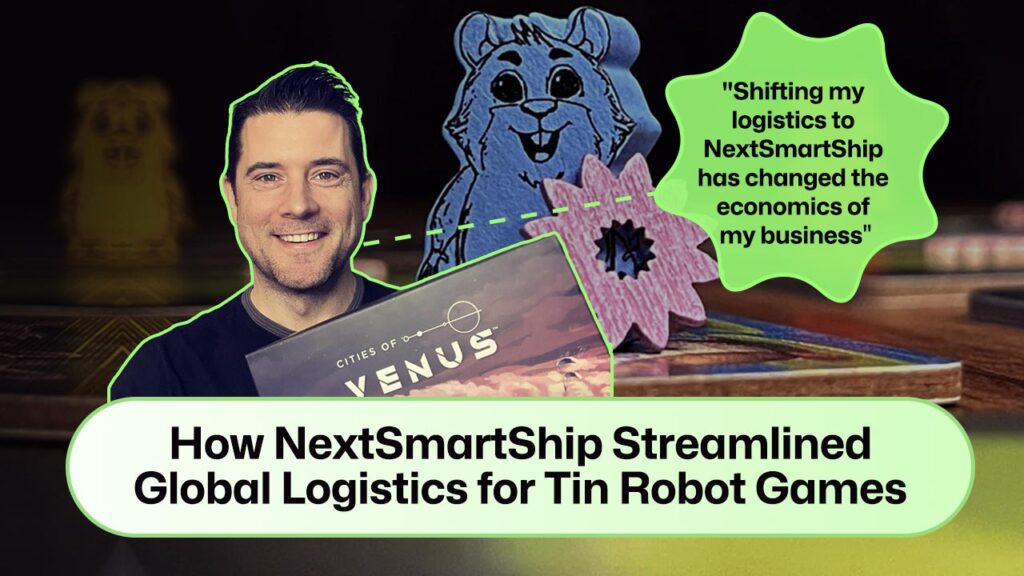
“Shifting my logistics to NextSmartShip has changed the economics of my business,” Staley said. “And I tell my fellow entrepreneurs about the company every chance I get. So far, I think I’ve referred six people to NextSmartShip.”