


Ship a box of books cross-country at regular postage rates, and the bill can be genuinely painful. That’s the exact problem Media Mail was built to solve, and it’s still the cheapest way to move printed and recorded material through USPS almost ninety years after it first showed up.
It’s also one of the more misunderstood services USPS offers, mostly because the eligibility rules are narrower than people assume, and the penalty for guessing wrong isn’t small. This guide covers what actually qualifies, what it costs in 2026, how long it takes, and the enforcement rule that catches a lot of sellers off guard.
What Is USPS Media Mail?
Before getting into pricing or restrictions, it helps to know exactly what this service is built for and why it’s priced so differently from everything else USPS offers.
A Quick Definition
Media Mail is a USPS shipping class reserved for educational and media content, priced by weight rather than distance. That last part matters more than it sounds like it should. A three-pound package of books costs the same whether it’s going two towns over or across the entire country, which is unusual among USPS services. Pricing runs per pound, tracking is included at no extra charge, and there’s no built-in insurance, though it can be purchased separately if needed.
The tradeoff for that low price is a narrow set of rules about what’s actually allowed inside the box, and USPS enforces those rules more aggressively than most people expect.
Where Media Mail Came From
The service isn’t new. Government publication records from late 1938 document the Post Office Department introducing a new postage rate specifically for books that year, informally known at the time as “book rate.” The idea was straightforward: make it cheap enough to mail books and educational material that cost wouldn’t stand in the way of distributing them. Over the following decades, the category expanded to cover records, tapes, CDs, and eventually DVDs and other recorded media, which is how it ended up with the broader “Media Mail” name it carries today.
That original mission, keeping educational content affordable to ship, is still baked into the eligibility rules, even though a lot of what moves through Media Mail today is just people reselling used books and DVDs online.
What Actually Qualifies for Media Mail
This is where a lot of sellers get tripped up, since the category sounds broader than it actually is.
Items That Are Eligible
According to USPS’s own Domestic Mail Manual, Media Mail and Library Mail pricing applies based strictly on weight, and the content itself has to fall into specific categories to qualify. Books with at least eight pages qualify, along with sound recordings like CDs and vinyl, video recordings such as DVDs, printed music, computer-readable media containing prerecorded educational content, play scripts, and certain medical or legal reference materials. None of these can contain advertising, which disqualifies most catalogs and magazines even though they’re technically printed material.
What Doesn’t Qualify
Plenty of things people assume are fair game actually aren’t. Blank media, like empty CDs or unrecorded tapes, don’t qualify, since the discount is meant for finished educational content, not storage media. Magazines and periodicals with ad content are excluded too. Personal correspondence, computer software that isn’t strictly educational, video game discs (a common one people get wrong), and merchandise bundled in with an otherwise eligible item can all disqualify a shipment or get it reclassified.
Media Mail Rates in 2026
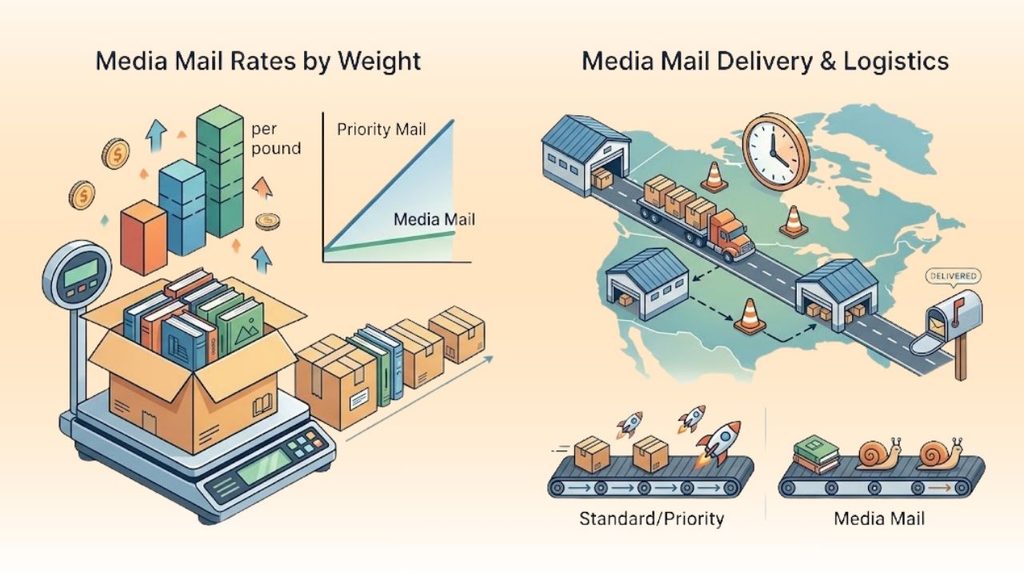
Pricing runs per pound, with the first pound priced highest and each additional pound adding a smaller, consistent increment. Based on current 2026 rate filings, a one-pound Media Mail package starts around $4.39, with each additional pound adding roughly seventy cents to a dollar depending on the exact weight bracket, up to a 70-pound maximum per package.
That per-pound structure is what makes Media Mail rates so much cheaper than alternatives for heavier shipments. A textbook that might cost $12 to $14 to ship via Priority Mail can often go out for a third of that through Media Mail, and the gap only widens as weight increases, since Media Mail pricing doesn’t scale with distance the way other classes do.
However, if your catalog includes non-qualifying goods or mixed items that require standard parcel rates, reviewing a broader UPS vs. USPS rate and weight comparison is vital to ensure you pick the most cost-effective carrier as box weights climb.
Media Mail Delivery Time
Because packages travel exclusively via surface logistics with low sorting priority, consulting a guide to selecting ground shipping providers helps merchants decide when economical ground tiers make sense versus when faster commercial networks are required.
For anything that isn’t time-sensitive, that slower window is a reasonable trade for the savings. For anything a buyer needs quickly, it’s worth flagging that expectation upfront rather than letting Media Mail delivery time catch someone off guard.
The Inspection Rule Most People Don’t Know About
Here’s the part of Media Mail that genuinely surprises people the first time they hear it.
USPS holds the right to open and inspect any Media Mail package during transit without prior notice, specifically to confirm the contents match what the discounted rate is meant to cover. This isn’t a rare, theoretical power either. It’s built directly into how the service is enforced, precisely because the discount is steep enough that people are tempted to stuff in ineligible items to save money on unrelated shipments.
If an inspection turns up something that doesn’t qualify, the package usually gets handled one of two ways. It either gets returned to the sender, or it gets delivered anyway with the recipient on the hook for the postage difference, sometimes bumped all the way up to Priority Mail rates. Neither outcome is good, which is exactly why sticking closely to the eligibility list matters more with Media Mail than it does with almost any other USPS class.
Media Mail vs Other USPS Shipping Options
| Feature | Media Mail | Ground Advantage | Priority Mail |
| Content restrictions | Yes, strict eligibility rules | No | No |
| Pricing basis | Weight only | Weight and distance | Weight and distance |
| Typical delivery time | 2 to 8 business days | 2 to 5 business days | 1 to 3 business days |
| Starting retail rate | Around $4.39 (1 lb) | Higher than Media Mail | Higher than both |
| Tracking included | Yes | Yes | Yes |
| Insurance included | No, purchased separately | Limited | Limited, varies |
| Subject to content inspection | Yes | No | No |
| Best for | Books, CDs, DVDs, printed music | General packages, mixed content | Time-sensitive shipments |
How to Package and Label a Media Mail Shipment
Getting a Media Mail package accepted correctly comes down to a few habits worth building early. Label the package clearly as “Media Mail” so it’s routed and priced correctly from the start. Keep the box weight-appropriate, since Media Mail tops out at 70 pounds and a combined length plus girth of 108 inches. Leave any promotional inserts, order forms, or advertising material out of the box entirely, since even a single flyer can technically disqualify the shipment during an inspection. And always include a return address, since it’s required for eligibility and gives USPS somewhere to send the package back to if something inside doesn’t check out.
Common Mistakes People Make With Media Mail
A handful of errors account for most of the problems sellers run into. Shipping video games under Media Mail is a frequent one, since people assume “DVD” covers anything disc-shaped, but interactive software and games don’t qualify the same way a movie or educational program does.
Including a handwritten note or invoice inside the package is another small but real risk, since personal correspondence technically falls outside Media Mail eligibility. And underestimating delivery time is a softer mistake, more of a customer service issue than a rules violation, but it’s still one of the more common complaints tied to the service.

Frequently Asked Questions
Here are some FAQs about USPS Media Mail that you should know about:
Books with at least eight pages, CDs, DVDs, vinyl records, printed music, play scripts, and certain educational or reference materials generally qualify. Items can’t contain advertising content, and things like blank media, video games, and personal letters are excluded.
Yes, Media Mail is available to non-contiguous states, offshore territories, and military APO/FPO/DPO ZIP codes at standard domestic rates. However, transit times stretch substantially because these shipments move primarily by ocean surface freight rather than air cargo, frequently taking three to six weeks to arrive.
Media Mail rates start around $4.39 for a one-pound package, with each additional pound adding roughly seventy cents to a dollar depending on weight, up to a 70-pound limit per package.
Media Mail delivery time typically runs two to eight business days. There’s no formal delivery guarantee attached to the service, so it’s worth padding expectations, especially during busy shipping periods.
Yes. USPS can open Media Mail shipments during transit without advance notice to confirm the contents qualify for the discounted rate. Packages with ineligible items can be returned or delivered with additional postage charged.
No. Video games are generally treated as software rather than educational or recorded media, so they don’t qualify for Media Mail, even though people frequently assume discs of any kind are covered.
Tracking is included at no extra cost. Insurance isn’t automatically included, but it can be purchased separately if the shipment needs additional coverage.
Unlike USPS Ground Advantage and Priority Mail, which scale pricing upward across eight domestic postal zones based on distance. Media Mail is zone-blind within the United States. A three-pound package of books costs the same rate whether shipping locally within Zone 1 or cross-country to Zone 8.
Final Thoughts
Media Mail is still one of the better deals USPS offers, as long as what’s going in the box actually matches what the service was built for. The pricing is hard to beat for books, CDs, and similar media, especially on heavier packages headed across the country. The tradeoff is a slower delivery window and a real, enforced content restriction that can turn into an expensive surprise if it’s ignored. Stick to the eligibility list, label things correctly, and the savings hold up exactly the way they’re supposed to.