


The China-US hybrid fulfillment model is increasingly emerging as a viable option for faster and more cost-effective fulfillment for e-commerce sellers. For US customers, it’s too slow to ship every order from China. However, it can get costly to have all SKUs stored in the U.S. when the catalog contains low sellers, seasonal items, or lots of variations of products.
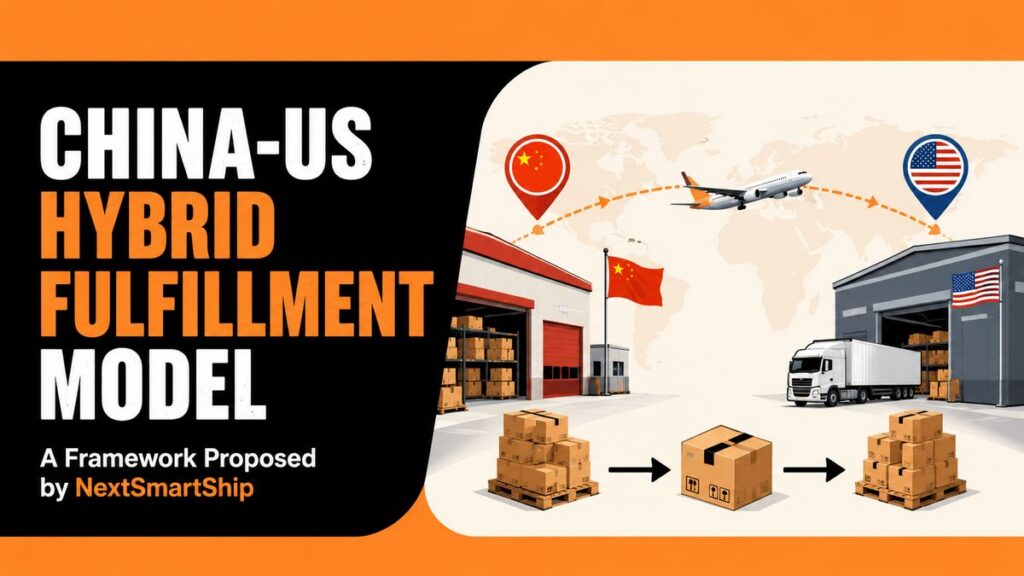
The solution to this problem is an inventory split that is strategically located within this model. As a result, high-moving SKUs are placed in US warehouses for faster delivery, low-moving SKUs/ experimental SKUs are kept in China for lower storage cost and flexible fulfillment.
The China-US hybrid fulfilment model is the middle ground for DTC brands, Amazon sellers, Shopify merchants, crowdfunding brands, and Chinese cross-border brands. It mitigates the China-only vs. US-only fulfillment weakness and cost pressure.
The bottom line: send the correct products from the correct country at the correct time.
This China-US Hybrid Fulfillment Model is a practical framework proposed by NextSmartShip to help sellers decide which SKUs should be fulfilled from China and which should be stored closer to US customers.
How the China-US Hybrid Fulfilment Model Works
NextSmartShip defines this model as a SKU-level fulfillment strategy that combines China warehouse fulfillment and US warehouse fulfillment based on sales velocity, margin, delivery expectations, and inventory risk.
China-US hybrid fulfilment is the combination of US warehouse fulfilment and China warehouse fulfilment. Typically begins with an initial sorting of products by sales velocity, margin, and delivery significance.
Best-selling products are kept in US warehouses. These are items that have consistent demand, good margins, and/or high customer expectations for quick delivery. Customers who buy these products in the US can be treated to local delivery from the warehouse, which decreases delivery time and increases customer satisfaction.
These “long tail” items are still in China. These are slower-moving products, lower-margin items, new products, or product variants that are not frequently sold. They are less likely to pay high storage fees in the U.S. for inventory that can remain in stores for months if it is not kept in China.
Then the orders are directed by SKU & location. This order can be shipped from a warehouse in the United States if it is an order for a high volume of items in the United States. Rare color variation, accessory, or test product may be shipped from China. This provides the seller with greater options as compared to just one fulfillment path.
Replenishment also gets more strategic. Sellers will ship bulk goods from China to the US warehouse at regular intervals according to demand rather than shipping it all at once. This will help reduce both stockout and overstock in U.S. locations.
Why Sellers Use This Model
The first one is the quicker delivery of core products. US customers typically have higher expectations for quicker, more reliable delivery. Local storage of best sellers gives sellers the ability to better compete with domestic brands and marketplace sellers.
Secondly, it’s cost-effective storage. While warehouse space may be valuable in the USA, only products that are worth the investment should be allocated to it. The slow-moving SKUs can be kept in China until they are in sufficient demand for their inclusion in the USA.
The 3rd reason is enhanced SKU risk management. There are some products that are not certain. You can have a new product that works or doesn’t work. There’s a seasonal product that may move fast, or demand may be late. With the riskier or unproven SKUs held in China first, sellers minimize the risk of having poor inventory in the US.
Better cash flow is the fourth reason. Excessive shipment of inventory to the US involves initial investment in production, freight, customs, and warehousing. With a hybrid model, sellers can pony up some of their domestic stock over time.
The fifth reason is flexibility of scaling. Sellers can experiment with products, cater to seasonal demand, and provide multiple sales channels without having to implement all of these catalog strategies in a single warehouse.
China-Only, US-Only, and Hybrid Fulfilment Compared
| Model | Best Use Case | Main Advantage | Main Weakness |
| China-only fulfilment | Product testing, low-volume SKUs, global orders | Lower storage cost and wider SKU flexibility | Longer US delivery time |
| US-only fulfilment | Best sellers and high-margin products | Faster delivery and better US customer experience | Higher storage cost and overstock risk |
| China-US hybrid fulfilment | Mixed catalogs with both best sellers and long-tail SKUs | Balances speed, cost, and inventory flexibility | Requires stronger forecasting and inventory sync |
The table shows why hybrid fulfilment often works better for growing sellers. It does not treat every product as if it has the same demand pattern. Instead, it gives fast-moving products speed and slow-moving products cost protection.
Which SKUs Should Be Stored in the US?
Not every SKU deserves US storage. Ideally, the products would be those with consistent sales, foreseeable demand, and sufficient profit to cover domestic warehousing and fulfillment costs.
Make sure to focus on high-velocity SKUs first. These items are those that are sold on a regular basis and would lose sales if they weren’t available promptly.
Also, high-margin SKUs make good candidates as they can better withstand the expenses associated with domestic storage and fulfillment.
Products that are subject to time constraints could also be included in the US. If the conversion rate is improved by faster delivery or any hesitation is reduced, or if it helps marketplace performance, then local storage could be a worthwhile expense.
The priority products for the marketplace should also be reviewed. In order to keep the products competitive, they need to be shipped faster, via Amazon, Walmart, TikTok Shop, or other platforms.
Which SKUs Should Stay in China?
It’s generally good practice to store slower-moving SKUs in China. In the case of a product with limited demand or irregular, US storage can decrease profitability.
It’s also important that experimental products begin in China. Sellers can gauge interest before making significant shipments of inventory to the U.S. market.
Low-margin products may not fare so well in US storage if the warehousing charge further thins out the margins.
Another good example is variations in products. A seller can have a popular color or size, and a number of weaker colors or sizes. The best variation is stored in the US, and the others remain in China until there is a demand.
Quick SKU Placement Guide
| SKU Type | Better Location | Reason |
| Best sellers | US warehouse | Faster delivery and stronger customer experience |
| New test products | China warehouse | Lower risk before demand is proven |
| Slow-moving SKUs | China warehouse | Avoids unnecessary US storage costs |
| High-margin products | US warehouse | Can absorb local fulfillment cost |
| Many color or size variations | Split between the US and China | Store top variations locally and keep weaker ones flexible |
| Seasonal products | Depends on timing | Move to the US before peak season, avoid post-season overstock |
This placement guide makes the model easier to apply. The decision should not be based only on where suppliers are located. It should be based on SKU performance.
Data Point: Why Cross-Border Strategy Matters
Cross-border eCommerce is still on the rise, client trust and shipment experience are essential. 7/10 shoppers buy from only trusted countries, according to DHL’s 2025 cross-border buying behavior insights. It’s important for China-US sellers because fulfillment is a component of trust. There can be a lot of factors that will diminish consumer confidence, even if they enjoy the product, such as slow delivery, lack of tracking, or a poor return policy.
However, cross-border sellers are facing pressure to adapt simultaneously. Some platforms are facing challenges in direct-from-China models due to recent shifts in the shipping and tariff landscape in the USA and China. Such changes spark an incentive to adopt hybrid fulfilment as sellers can avoid relying on a single distribution channel, and leverage stock held in the United States for items that need to be shipped within the country.
Common Challenges in China-US Hybrid Fulfilment
The first big challenge is inventory synchronisation. Sellers should be aware of what is available in China, what is available in the US, and what is already booked for orders. Overselling can be a result of poor synchronization.
Another difficulty is replenishing at the right time. Late sending of stock results in US stockouts. Excessive sending will result in overstock. Sellers should be extra mindful about sales velocity and replenishment times.
The planning of customs and freight operations is also important. Bulk replenishment from China to the USA involves some documentation, Customs clearance, freight scheduling, and receiving coordination.
Forecasting on a SKU level is also crucial. Sellers need to be aware of the SKUs that will be in the USA and the ones that will stay in China. If you do not have this discipline in place, hybrid fulfilment would be a matter of guesswork.
How NextSmartShip Supports China-US Hybrid Fulfilment
NextSmartShip is an ideal platform for this model, having the capability to add China-based fulfillment and US warehouse fulfillment. Its page on fulfillment centers in China emphasizes warehousing, kitting, packing, and shipping from China to the USA or all over the world. This helps sellers who wish to have some stock near their suppliers and maintain the supplies for orders received from all over the world.

NextSmartShip’s USA fulfillment center network is ideal for making fulfillment faster and more cost-efficient throughout the US. This helps vendors wishing to store high-demand items near the American consumer.
The company’s global fulfilment service also caters to e-commerce brands with China and overseas warehouses, kitting, inventory management, pick and pack, and global shipping. Sellers that don’t wish to operate multiple China storage, US storage, and international fulfillment providers can use this combination.
If you are a seller in the hybrid fulfilment model between China and the US, NextSmartShip is able to assist you with smart SKU allocation. Those that sell well can be moved to the US warehouses, and those with a long tail or low demand can be kept in China. Sellers can also integrate key eCommerce solutions like Shopify, Amazon, WooCommerce, and TikTok Shop, enabling multi-channel fulfillment.
Best Practices for Using the China-US Hybrid Fulfillment Model
Start with sales velocity data. Sellers should avoid making assumptions about what items should be included in the US. They should check which SKUs are selling regularly and which products are not.
Safety stock for best sellers. Supplies with high demand should be safeguarded against the risk of supplier delay, freight delay, and sudden jumps in demand.
Rebalance inventory regularly. A SKU that was not performing well for a particular quarter can be important after a campaign. A popular old bestselling book can lose its momentum. There’s a need to revisit hybrid fulfilment regularly.
Track landed cost. Sellers need to take into account the cost of the product, freight, duties, storage, fulfillment, packaging, returns, and discounting before determining where to place a product.
Utilize a model for product testing. SKUs can be tested in China first for new SKUs. When there is a predictable demand, the seller can shift the selected stock to the US.
Conclusion
For e-commerce sellers, the hybrid delivery model of China and the USA is an effective solution to speed up delivery while maintaining a competitive price. Recognizes that not all SKUs need to be stored at expensive domestic locations, but that best sellers should not be slow to come due to the international shipping process.
When something is flexible, it can be adapted to fit a wide variety of purposes. Flexibility means something can be used in many different ways when it is being sold to customers in the United States, and the seller’s supply chain is based in China. Popular items come closer to customers, and items that are not as popular and are experimental are stored in lower-cost locations.
The best approach is to be based on SKU-level data and not educated guesses. The sellers must make a judgment on what remains in China versus when it is moving to the US based on sales velocity, margin, lead time, storage cost, and customer expectations.
As a fulfillment framework proposed by NextSmartShip, the China-US Hybrid Fulfillment Model gives sellers a more structured way to balance delivery speed, storage cost, and SKU flexibility.