Use China and local fulfillment together to place each SKU where it makes the most sense.
Keep fast-moving products closer to customers for faster delivery, while storing new, seasonal, long-tail, and less predictable inventory in China for greater flexibility.
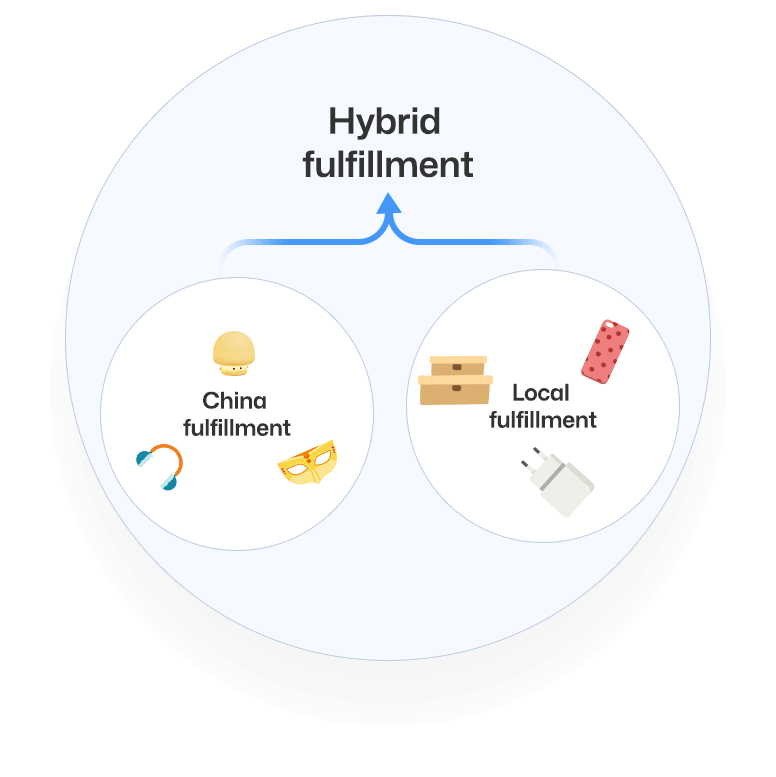
Hybrid fulfillment is a strategy that combines multiple fulfillment locations within the same operation, allowing brands to store and ship different products based on demand, customer location, and delivery needs.
Unlike a traditional model where inventory is concentrated in one warehouse, hybrid fulfillment lets fast-moving products sit closer to customers for faster local delivery, while slower-moving, new, or less predictable SKUs remain in China.
Traditional approach:
Factory → One Warehouse → Customers
Hybrid approach:
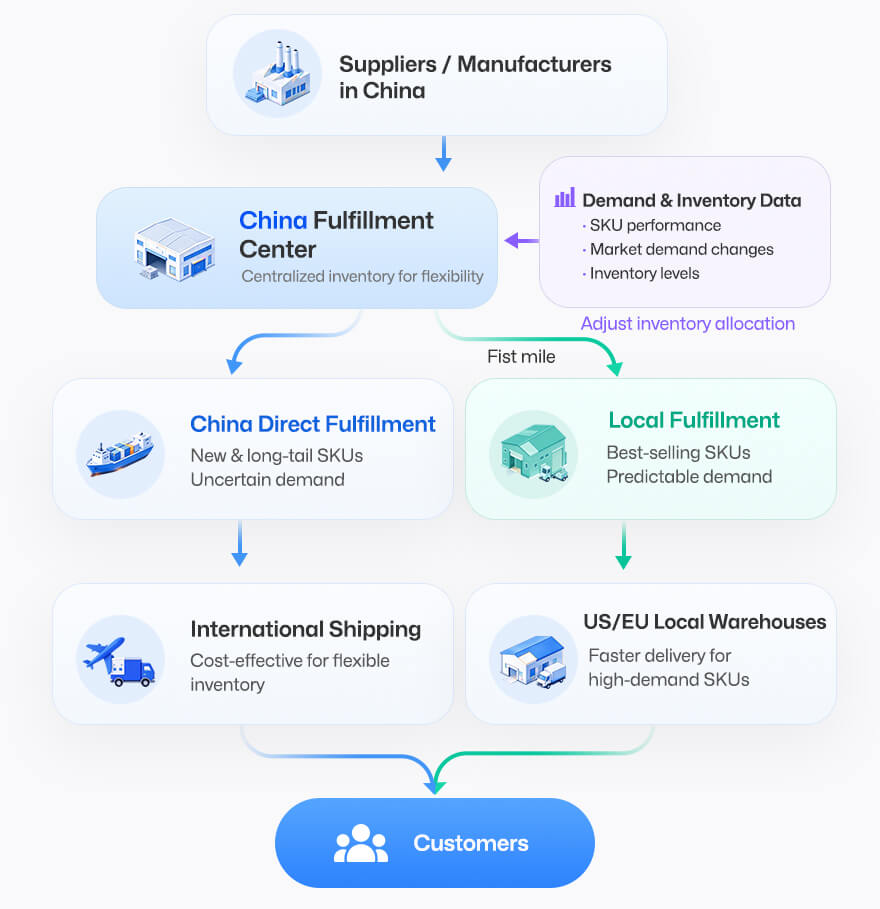
Factory → China Fulfillment Center → Global Customers
Factory / China Warehouse → Local Warehouse → Local Customers
Why Brands Use Hybrid Fulfillment
Hybrid fulfillment gives brands more control over where inventory is stored and how orders are fulfilled.
Build a setup around how your products actually sell — not a one-size-fits-all warehouse model.
01
Inventory Allocation
Put the right products in the right locations based on demand, sales velocity, and customer expectations.Keep fast-moving SKUs closer to customers while leaving slower-movingor less predictable inventory centralizedin China to avoid unnecessary local stock.
02
Smarter SKU Decisions
Use different fulfillment strategies for different products instead of treating the entire catalog the same. Best sellers and predictable SKUs can move to local warehouses, while new launches, seasonal products, and long-tail inventory can remain in China until demand becomes clearer.
03
Better cash flow
Avoid tying up too much working capital in inventory spread across multiple warehouses. A hybrid fulfillment setup lets you move selected inventory locally, scale stock gradually, and keep more cash available as demand changes.
04
Optimized ROI
The fastest delivery option is not always the most profitable fulfillment strategy. Balance storage costs, shipping expenses, delivery speed, and inventory risk across China and local fulfillment to support stronger overall returns.
How Hybrid Fulfillment Works
Keep flexible inventory in China, move proven SKUs closer to customers, and adjust allocation as demand changes.
Products are manufactured or sourced in China
Inventory enters the China fulfillment center directly from suppliers.
Flexible inventory stays in China
New products, long-tail SKUs, low-volume products, and uncertain-demand inventory can remain centralized.
Selected inventory moves to local warehouses
High-volume or predictable SKUs are replenished in bulk to markets such as the United States or Europe.
Orders are routed to the appropriate fulfillment location
Orders can be fulfilled locally when inventory is available or from China when appropriate.
Inventory allocation changes with demand
Brands can adjust which SKUs and quantities are stored locally as demand changes.
Which Fulfillment Model Fits Your Business?
Decision Factor
Upfront Inventory
Investment
Local Delivery
Speed
Market Testing
Flexibility
Fast-Moving &
Long-TailSKUs
Recommended
Stage
Direct Fulfillment
from China
Low
Moderate
High
Best for long-tail SKUs
Validation stage
Overseas
Warehousing
High
Fast
Low
Best for fast-moving SKUs
Stable growth stage
Hybrid
Fulfillment
Flexible
Fast
High
Combined strategy
Growth &multi-market
stage
Decision Factor
Direct Fulfillment
from China
Overseas Warehousing
Hybrid Fulfillment
Upfront Inventory Investment
Low
High
Flexible
Local Delivery Speed
Moderate
Fast
Fast
Market Testing Flexibility
High
Low
High
Fast-Moving & Long-TailSKUs
Best for long-tail SKUs
Best for fast-moving SKUs
Combined strategy
Recommended Stage
Validation stage
Stable growth stage
Growth &multi-market
stage
Hybrid Fulfillment by Growth Stage
Early Stage
Common challenges:
Unstable sales volume
Limited cross-border logistics experience
Limited fulfillment experience
What we offer:
Free onboarding
60 days of free storage
No minimum commitment
Free supplier coordination
Growth Stage
Common challenges:
Complex inventory management
Rising fulfillment costs
Higher customer expectations
What we offer:
AI inventory allocation
Improved cash flow
Faster fulfillment speed
Branded packaging
Mature Stage
Common challenges:
SLA control and peak season pressure
High warehouse handling costs
Need for better data analytics
What we offer:
SLA performance tracking
Peak season planning
China pre-packaging service
AI analytics dashboard
Used Cases of Hybrid Fulfillment
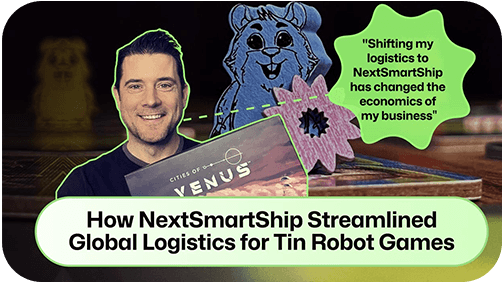
How NextSmartShip Streamlined Global
Logistics for Tin Robot Games
No. Hybrid fulfillment can also work well for growing brands that want faster delivery for proven products without committing their entire catalog to local warehouses.
Yes. A brand can stock selected products locally in its strongest markets while continuing to fulfill lower-volume regions from China. The setup can vary by market depending on demand, delivery expectations, and inventory requirements.
Yes. Many brands begin with centralized fulfillment while demand is still developing, then move selected SKUs to local warehouses once sales become more predictable. This allows the fulfillment setup to evolve with the business.
Inventory allocation can be adjusted as demand changes. Brands can reduce future replenishment quantities, keep additional stock centralized in China, or change which SKUs are prioritized for local fulfillment.
Yes. Different sizes, colors, bundles, or other variants can follow different fulfillment strategies if their sales patterns are different. High-volume variants can be stocked locally while slower-moving variants remain centralized.